# Visualization
Table of Contents
starter
What is an Operating System? 这个问题困扰了我很久,直到我终于下定决心好好阅读OSTEP这本书
CPU visualization
Process
电脑的物理CPU是有限的,但操作系统通过虚拟化CPU来创造出有无数CPU可用的情况, 通过让一个进程只运行一个 时间片,然后切换到其他进程,这是**时分共享(time sharing)**CPU技术,潜在开销是性能损失 <-CPU共享导致进程运行变慢
要实现CPU虚拟化,需要机制(mechanism)-> 低级的方法或协议,实现所需功能(eg. 上下文切换 content switch) 还需要策略(policy)->做某种决定的算法(eg. 调度策略 scheduling policy)
The Abstraction: A Process
进程(Process) : 操作系统为正在运行的程序提供的抽象
因此一个进程其实就只是一个正在运行的程序
进程的机械状态(machine state) : 程序在运行时可读取或更新内容
机械状态由两部分组成: 第一个是内存 <-指令&正在运行的程序读取和写入的数据 可以被进程访问到的内存是地址空间(address space) ,是该进程的一部分
第二个是寄存器 <-指令明确读取或更新寄存器 有些非常特殊的寄存器构成了机械状态的一部分(eg. 程序计数器 Program Counter, 栈指针 stack pointer, 帧指针 frame pointer…)
Process API
现代操作系统必须以某种形式提供以下API
- 创建(create) : 新建进程的方法
- 销毁(destroy) : 强制销毁进程的接口
- 等待(wait) : 等待进程停止运行
- 其他控制(miscellaneous control) : 有可能有的其他控制方法
- 状态(status) : 调接口获得进程的状态信息
Process Creation: A Little More Detail
在这是程序如何转化为进程
- 1.将代码和所有静态数据加载到内存中,加载到进程的地址空间
程序会以某种可执行格式驻留在磁盘上(或者在基于闪存的SSD上)
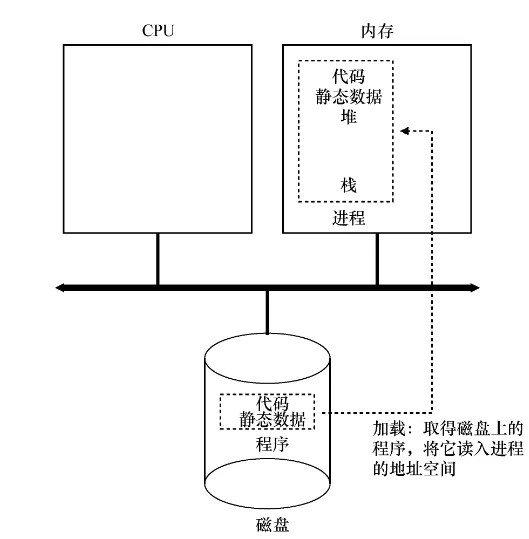
现代操作系统惰性(lazily)执行加载,即仅在程序执行期间需要加载的代码或数据片段,才会加载 在内存虚拟化时会说加载机制,你先别急
- 2.为程序的运行时栈(run-time stack 或 stack)分配一些内存
- 3.为程序的堆(heap)分配一些内存
- 4.执行一些其他初始化任务,特别是I/O相关任务
做完这些事情之后,OS将CPU的控制权转移给新创建的进程中,程序开始执行
Process State
进程可以处于以下3种状态之一:
- 运行(running)
- 就绪(ready) <-并不在此时运行,但是进程已经准备好了
- 阻塞(blocked) <- 一个进程执行了某种操作,直到发生其他事件时才会准备运行
当然还可以处于初始(initial) 和 最终(final / zombie in UNIX)状态
graph TD
    Running((运行))
    Ready((就绪))
    Blocked((阻塞))

    Running -->|"取消调度"| Ready
    Ready -->|"调度"| Running
    Running -->|"I/O: 发起"| Blocked
    Blocked -->|"I/O: 完成"| Ready
Interlude: ProcessAPI
The fork() System Call
#include <stdio.h>#include <stdlib.h>#include <unistd.h>int main(int argc, char *argv[]) { printf("hello (pid:%d)\n", (int) getpid()); int rc = fork(); if (rc < 0) { // fork failed fprintf(stderr, "fork failed\n"); exit(1); } else if (rc == 0) { // child (new process) printf("child (pid:%d)\n", (int) getpid()); } else { // parent goes down this path (main) printf("parent of %d (pid:%d)\n", rc, (int) getpid()); } return 0;}wsl跑了一下
$ gcc p1.c -o p1$ ./p1hello (pid:990)parent of 991 (pid:990)child (pid:991)fork()创建子进程,从创建的位置开始运行,而非main() fork()结束后,父进程和子进程都在内存内,输出结果取决于CPU调度程序(Scheduler) 因为无法预测操作系统的调度策略,所以程序的输出顺序时不确定的(non-deterministic) 在后序多进程程序(multi-threaded program)和并发(concurrency)时会更加明显
The wait() System Call
wait()系统调用会在子进程运行结束后才返回
#include <stdio.h>#include <stdlib.h>#include <unistd.h>#include <sys/wait.h>
int main(int argc, char *argv[]){ printf("hello world (pid:%d)\n", (int) getpid()); int rc = fork(); if (rc < 0) { // fork failed; exit fprintf(stderr, "fork failed\n"); exit(1); } else if (rc == 0) { // child (new process) printf("hello, I am child (pid:%d)\n", (int) getpid()); sleep(1); } else { // parent goes down this path (original process) int wc = wait(NULL); printf("hello, I am parent of %d (wc:%d) (pid:%d)\n", rc, wc, (int) getpid()); } return 0;}$ ./p2hello world (pid:1350)hello, I am child (pid:1351)hello, I am parent of 1351 (wc:1351) (pid:1350)父进程调用wait(),延迟执行,直到子进程执行完毕。当子进程结束时,wait()才返回父进程,使得程序输出结果变稳定了
Finally, The exec() System Call
它也是创建进程 API 的一个重要部分,可以让子进程执行与父进程不同的程序
#include <stdio.h>#include <stdlib.h>#include <unistd.h>#include <string.h>#include <sys/wait.h>
int main(int argc, char *argv[]){ printf("hello world (pid:%d)\n", (int) getpid()); int rc = fork(); if (rc < 0) { // fork failed; exit fprintf(stderr, "fork failed\n"); exit(1); } else if (rc == 0) { // child (new process) printf("hello, I am child (pid:%d)\n", (int) getpid()); char *myargs[3]; myargs[0] = strdup("wc"); // program: "wc" (word count) myargs[1] = strdup("p3.c"); // argument: file to count myargs[2] = NULL; // marks end of array execvp(myargs[0], myargs); // runs word count printf("this shouldn't print out"); } else { // parent goes down this path (original process) int wc = wait(NULL); printf("hello, I am parent of %d (wc:%d) (pid:%d)\n", rc, wc, (int) getpid()); } return 0;}$ ./p3hello world (pid:605)hello, I am child (pid:606) 35 120 1024 p3.chello, I am parent of 606 (wc:606) (pid:605)Why? Motivating The API
构建shell时好用 fork()和 exec()的分离,让 shell 可以方便地实现很多有用的功能
#include <stdio.h>#include <stdlib.h>#include <unistd.h>#include <string.h>#include <fcntl.h>#include <assert.h>#include <sys/wait.h>
int main(int argc, char *argv[]){    int rc = fork();    if (rc < 0) {        // fork failed; exit        fprintf(stderr, "fork failed\n");        exit(1);    } else if (rc == 0) {  // child: redirect standard output to a file  close(STDOUT_FILENO);  open("./p4.output", O_CREAT|O_WRONLY|O_TRUNC, S_IRWXU);
// now exec "wc"... char *myargs[3]; myargs[0] = strdup("wc"); // program: "wc" (word count) myargs[1] = strdup("p4.c"); // argument: file to count myargs[2] = NULL; // marks end of array execvp(myargs[0], myargs); // runs word count } else { // parent goes down this path (original process) int wc = wait(NULL); assert(wc >= 0); } return 0;}但幸运的是我们的init会一直wait()循环,有时候这个孤儿进程反而是很好被利用的点
Mechanism: Limited Direct Execution
通过时分共享(time sharing)CPU,实现了虚拟化
但构建该虚拟化机制,面临着要保持控制权的同时获得高性能的挑战
Basic Technique: Limited Direct Execution
受限直接执行(limited direct execution)
有受限那当然就有直接运行协议:
sequenceDiagram
    participant OS
    participant Program

    OS->>OS: 创建 PCB
    OS->>OS: 地址空间初始化
    OS->>OS: 加载代码段/数据段
    OS->>OS: 初始化用户栈(argc/argv)
    OS->>OS: 设置 CPU 上下文(PC, SP)

    OS->>Program: 切换到用户态,跳转到 main

    Program->>Program: 运行 main()
    Program->>Program: 执行用户逻辑
    Program-->>OS: return(退出)

    OS->>OS: 回收资源(内存/PCB)
但是这个方法在虚拟化CPU的时候会有问题
咕咕咕 ing 最近很忙